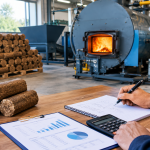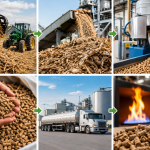
Consumer wood briquettes are the ideal products for replacing traditional firewood. Since the end of the 90s, the demand for consumer wood briquettes used for home heating systems, fireplaces, and wood-burning stoves has increased. Driven by the global focus on renewable energy, this need is still growing. Compared to alternatives, briquettes are both convenient, profitable, and sustainable.
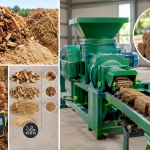
With our briquetting machines, your waste will be turned into beneficial renewable energy. We offer a broad range of customized solutions and a full line of customer briquetting machines, ranging from low to very high capacities. We have specialized in mechanical briquetting. We offer high-capacity lines ranging from 4-500 kg/hour and upwards, corresponding to wood waste of approximately 1.000 tonnes per year and more.
The difference between briquettes and pellets mainly comes down to size, production process, and usage. Both are made from biomass waste, but briquettes are larger and denser, making them perfect for industries and large-scale heating, while pellets are smaller, more uniform, and often used in household stoves or small boilers.
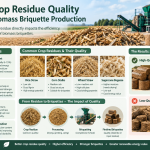
With the help of a briquetting machine, waste materials like sawdust, rice husk, and other residues can be converted into solid fuel blocks. This makes them an affordable, eco-friendly, and efficient alternative to coal and firewood.
What are briquettes and pellets?
-
Briquettes: These are solid blocks created by compressing biomass such as wood waste, crop residue, and forestry by-products. They usually come in cylindrical, square, or rectangular shapes. Briquettes burn slowly and provide long-lasting heat because of their higher density.
-
Pellets: These are much smaller, uniform cylinders—about the size of a fingertip. Pellets are made by grinding raw material into fine particles and pressing it through a pellet mill. They need raw material with low moisture (6–10%) and are commonly used in automated pellet stoves or small-scale heating systems.
Where are they used?
-
Briquettes
-
Industrial boilers and kilns
-
Power plants
-
Replacement for firewood and coal
-
Rural and semi-urban household heating
-
-
Pellets
-
Automated pellet stoves
-
Residential boilers
-
Small commercial setups
-
Advantages of briquetting versus pelletizing
- Investment costs – are less for a briquetting plant, not only the press itself, but also all other structures such as electrical installation, cooling, size of buildings, etc.
- Operational costs – power consumption is less, particularly as the raw material does not need to be downsized to the same extent. Spare part costs are lower, and operations are simple.
- Simple technology – a briquetting press can be performed by experienced laborers and does not need much education.
- Moisture content – a briquetting press can handle a higher range of moisture in raw material, from 6-18%
- Decentralized production – briquettes can be produced on-site where the raw material is, thus saving considerable logistical costs.
- Logistical costs – briquettes have a high bulk density, but are, in comparison with pellets, best for shipping on a truck as the bulk density is sufficient to reach the maximum tonnage on a truckload.
- Developing countries – briquettes produced on a mechanical press can be made from many types of wastes, including agricultural wastes, and replace firewood and charcoal.
Also read: Biomass Briquetting Machine & Its Various Types
Why is biomass fuel demand growing in India?
India generates more than 500 million tonnes of biomass every year, most of which is either wasted or openly burned. This not only harms the environment but also wastes valuable energy.
With rising fuel prices and government support under the National Bioenergy Programme, the demand for biomass briquettes is increasing rapidly. A briquetting machine helps industries turn agro-waste into energy, giving them both economic and environmental benefits.
Final thoughts
Both briquettes and pellets are effective renewable fuels, but briquettes often provide more benefits for industries and large-scale users. They are cost-effective, versatile, and easier to produce with the help of a briquetting machine. For businesses in India, briquettes not only cut fuel costs but also support cleaner energy and a greener future.