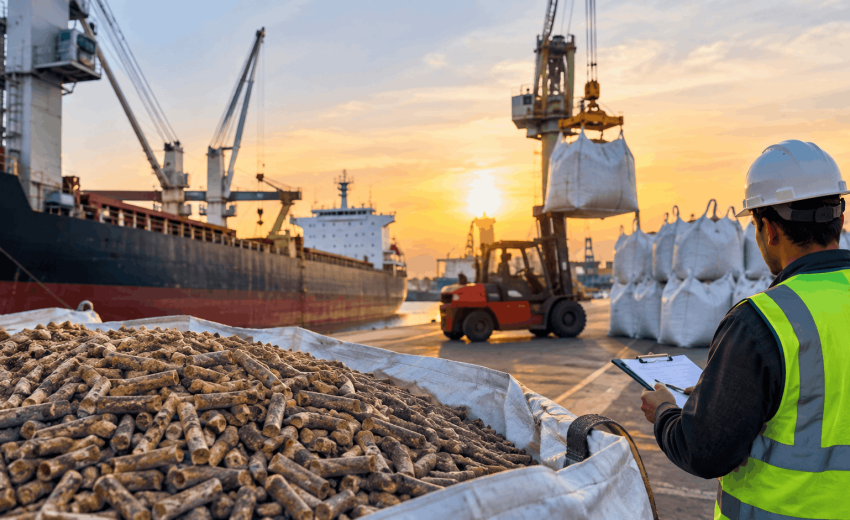
Global demand for biomass biofuels is growing as industries and energy producers look for lower-carbon alternatives to conventional fossil fuels. Biomass pellets are particularly important because they are compact, transportable, and suitable for applications such as industrial heating, boilers, and power generation. Europe and parts of Asia remain important markets, creating opportunities for producers that can supply consistent-quality pellets at competitive delivered costs.
For biomass business owners, this creates an opportunity to move beyond local fuel markets and explore international pellet trade. However, exporting successfully requires more than simply producing pellets. Feedstock availability, moisture and ash content, calorific value, sustainability requirements, packaging, logistics, certifications, and long-term supply agreements can all affect the final business margin.
For producers in Rajkot, India, the opportunity is especially relevant because India has a large agricultural and industrial biomass base. The Ministry of New and Renewable Energy (MNRE) has also supported biomass pellet and briquette manufacturing through its National Bioenergy Programme.
What is driving the global biomass pellet export market?
Several factors are supporting the development of the international biomass pellet market.
1. Demand for renewable and alternative fuels
Industries are looking for ways to reduce their dependence on coal and other fossil fuels. Biomass pellets can be used as a solid biofuel in suitable combustion systems and can be produced from materials such as agricultural residues, forestry residues, and other biomass resources.
India itself has been promoting biomass utilization. For example, government policies have required biomass co-firing in certain coal-based thermal power applications. Current policy documents also provide for biomass pellet use in thermal power plants.
2. Agricultural waste creates a valuable feedstock
Rice husk, sawdust, groundnut shells, cotton stalks, wheat straw, and other residues can potentially be processed into densified biomass fuels.
Instead of treating agricultural residues only as waste, producers can convert suitable materials into a standardized fuel product.
India’s Ministry of New and Renewable Energy reported that the country has substantial biomass availability, including agricultural and forestry residues, with surplus biomass available for energy applications.
3. International buyers need consistent fuel quality
Large industrial users generally need predictable fuel characteristics. Important parameters can include:
- Moisture content
- Ash content
- Calorific value
- Pellet diameter
- Bulk density
- Durability
- Fines percentage
- Raw-material origin
- Sustainability characteristics
This means a producer with reliable quality control can potentially compete more effectively in the biomass pellet export market.
Why is biomass pellet demand in Europe important?
Biomass pellet demand in Europe is connected to renewable-energy policies, industrial heating, district heating, residential heating in some markets, and power-generation applications.
Europe is not a single market. Each country can have different energy policies, sustainability rules, import requirements, and buyer specifications. Therefore, exporters should research the specific destination country before making investment or production decisions.
Why Europe imports biomass pellets
So, why does Europe imports biomass pellets when European countries also have their own biomass resources?
The simple answer is that domestic supply does not always match demand, location, seasonality, quality specifications, or price expectations.
Importers may source pellets internationally when overseas suppliers can meet their required specifications and delivered cost.
For exporters, the key lesson is that production cost alone does not determine competitiveness. The relevant number is the delivered cost at the destination.
A simplified calculation is:
Delivered pellet cost = Production cost + Inland transportation + Handling + Port charges + Freight + Insurance + Other export costs
An exporter should compare this figure with the buyer’s target price before assuming that an overseas market will provide high margins.
What is happening with biomass pellet demand in Asia?
Biomass pellet demand in Asia is also important, particularly in markets where biomass is used for industrial energy, heating, or power generation.
Countries such as Japan and South Korea have developed biomass-energy markets, while other Asian economies are also exploring biomass as part of broader renewable-energy strategies.
Historical international energy data has identified Asia as a biomass pellet market, particularly Japan and South Korea, alongside European markets.
For Indian producers, Asian destinations can have a potential logistical advantage compared with more distant markets, depending on the port, destination, freight rates, product specifications, and contract terms.
What are the latest global biomass pellet market trends?
The major global biomass pellet market trends that biomass businesses should monitor include:
- Greater focus on sustainability – Buyers increasingly want traceable and responsibly sourced biomass.
- Demand for consistent quality – Industrial buyers need predictable fuel performance.
- Growth of densified biomass fuels – Pellets make loose agricultural residues easier to handle, store, and transport.
- Long-term supply relationships – Large users may prefer dependable suppliers instead of relying only on spot purchases.
- Greater attention to logistics – Freight and port costs can significantly change export economics.
- Improved pellet technology – Producers are evaluating conventional and torrefied pellet technologies for different applications.
- More organized domestic biomass markets – India’s policies are encouraging structured biomass utilization and supply chains.
India’s biomass policy environment is also evolving. MNRE revised its biomass programme guidelines in 2025, with changes intended to support biomass utilization and simplify processes for the sector.
Can exporting biomass pellets be a high-margin business?
It can be, but “high margin” should never be treated as guaranteed.
A biomass pellet export business can become attractive when a producer has:
- Low-cost and reliable feedstock
- Efficient pellet production
- High plant utilization
- Consistent product quality
- Competitive electricity and processing costs
- Efficient local transportation
- Access to suitable ports
- Strong export logistics
- Repeat international buyers
- Favorable long-term contracts
At the same time, margins can fall because of:
- Rising raw-material prices
- Seasonal feedstock shortages
- High electricity costs
- Pellet quality problems
- Ocean freight increases
- Port delays
- Currency fluctuations
- Rejected or downgraded shipments
- Changes in sustainability regulations
Therefore, business owners should calculate net export margin, not just the difference between manufacturing cost and international selling price.
What should Indian biomass businesses consider before exporting?
Before entering international markets, a biomass business should evaluate the complete supply chain.
Step 1: Identify the feedstock
Determine which agricultural or industrial residues are available locally and whether supply is reliable throughout the year.
Step 2: Test the raw material
Analyze moisture, ash, calorific value, particle characteristics, and other relevant properties.
Step 3: Select appropriate pellet technology
Production technology should match the raw material and target product specification. Some applications may require conventional non-torrefied pellets, while others may have different technical requirements.
Step 4: Calculate production economics
Include:
- Raw material
- Electricity
- Labor
- Maintenance
- Depreciation
- Packaging
- Storage
- Internal transportation
Step 5: Research destination markets
Compare biomass pellet demand in Europe and biomass pellet demand in Asia rather than assuming one market is automatically better.
Step 6: Verify export requirements
Check the current requirements of the destination country, buyer, port, and applicable sustainability or product-certification schemes.
For India, exporters should also verify the applicable DGFT classification and export policy. DGFT documentation has specifically addressed agricultural-residue biomass and briquettes/pellets under the relevant HS classification.
Step 7: Calculate delivered cost
Never evaluate an export order only on the factory-gate selling price.
Step 8: Build reliable buyer relationships
Long-term agreements can help producers plan feedstock procurement, production volumes, inventory, and logistics.
How can Ronak Engineering support biomass pellet production planning?
For biomass business owners evaluating pellet production, Ronak Engineering can be considered as part of the equipment and plant-planning discussion.
The right equipment configuration depends on the raw material, required capacity, pellet specifications, moisture level, and intended application. A proper feasibility study should therefore come before selecting machinery.
Businesses in Rajkot, India, and other manufacturing regions can evaluate local feedstock availability, transportation costs, power requirements, and access to domestic or export markets before finalizing a project.
What makes Europe and Asia attractive compared with only selling locally?
Export markets can potentially provide access to a larger pool of industrial buyers.
However, international sales introduce additional costs and compliance requirements. The best market is not necessarily the country offering the highest headline selling price. It is the market where the exporter can achieve a sustainable margin after production, transportation, certification, handling, port, freight, financing, and other costs.
A practical market comparison should therefore look like this:
Factor | Europe | Asia |
Potential demand | Established biomass markets | Established and developing markets |
Buyer requirements | Often detailed and market-specific | Market-specific |
Logistics | Depends strongly on destination port | Can be favorable for some Indian exporters |
Competition | International suppliers | Regional and international suppliers |
Key opportunity | Renewable energy and industrial applications | Industrial energy and biomass applications |
Main consideration | Sustainability and delivered cost | Quality, price and logistics |
What should biomass business owners do next?
The global biomass sector offers opportunities, but successful exporters need a data-driven approach.
Start with a feasibility study covering:
- Available feedstock
- Annual production capacity
- Pellet quality
- Production cost per tonne
- Domestic selling price
- Target export markets
- Port and freight costs
- Buyer specifications
- Certification requirements
- Expected net margin
India’s domestic market itself is developing through biomass co-firing policies and other biomass-utilization initiatives. In 2026, the government reported enforcement action related to compliance with biomass co-firing requirements at certain thermal power plants, showing that biomass utilization remains an active policy area.
For a producer, this means export should be evaluated alongside domestic opportunities rather than treated as the only growth path.
Final takeaway
Global demand for biomass biofuels creates opportunities for biomass producers who can turn locally available residues into consistent, transportable, and commercially competitive fuel. Europe and Asia can both offer potential export markets, but successful international trade depends on much more than demand alone.
For biomass business owners in Rajkot, India, the strongest approach is to combine reliable feedstock sourcing, efficient pellet production, quality control, careful market selection, accurate delivered-cost calculations, and strong buyer relationships. With proper planning, biomass pellet manufacturing can serve both India’s growing renewable-fuel market and selected international markets.
Ronak Engineering can join the equipment and production-planning conversation for businesses evaluating biomass pellet opportunities. The key is to assess the complete economics before investing: feedstock → production → quality → logistics → market → final margin. Frequently asked questions about global biomass biofuels
FAQ
1. Why is biomass pellet demand increasing globally?
Demand is being supported by the use of biomass in renewable energy, industrial heating, boiler, and power-generation applications. Policy support and efforts to reduce fossil-fuel dependence can also influence demand.
2. Why does Europe import biomass pellets?
Europe imports biomass pellets when international suppliers can meet specific quality, sustainability, volume, and delivered-cost requirements. Domestic production may not always match demand in every market.
3. Is biomass pellet export profitable from India?
It can be profitable when producers have competitive feedstock and manufacturing costs, efficient logistics, suitable product quality, and reliable buyers. Profitability should be calculated after all export and logistics expenses.
4. Which is better for biomass pellet exports: Europe or Asia?
There is no universal answer. The better market depends on buyer specifications, selling price, freight, sustainability requirements, competition, and the producer’s delivered cost.
5. What quality factors matter when exporting biomass pellets?
Important factors can include moisture, ash, calorific value, durability, bulk density, dimensions, fines, and sustainability or traceability requirements. The exact specification should always be confirmed with the intended buyer.