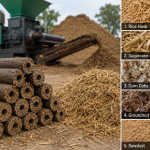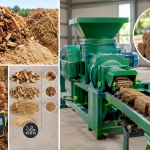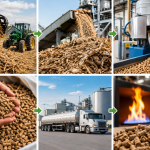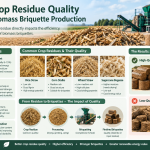
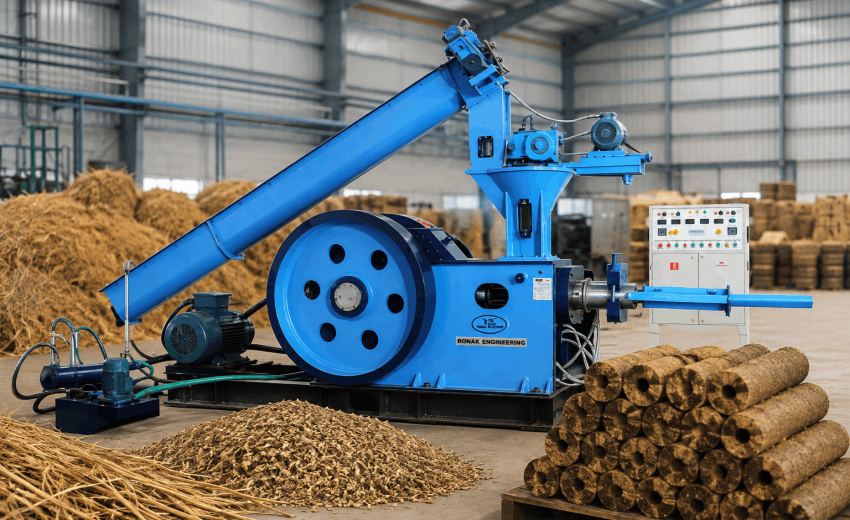
To produce briquettes from agricultural waste, collect and prepare suitable biomass residues, reduce their size, control moisture, and compress the prepared material under high pressure using a briquetting machine. Depending on the raw material and equipment, the process may also include screening, drying, conveying, cooling, and storage.
Common agricultural residues used for biomass briquettes include crop stalks, straw, groundnut shells, rice husk, cotton stalks, corn residues, and other dry plant-based materials. The exact preparation requirements vary according to the material and briquetting technology.
For biomass business owners, understanding how to produce briquettes from agricultural waste is important because proper raw-material preparation directly affects production efficiency, briquette strength, storage stability, and fuel performance.
The basic process is:
Agricultural waste → Size reduction → Drying/moisture control → Screening → Feeding → Compression → Cooling → Storage
Why convert agricultural waste into briquettes?
Agricultural activities generate large quantities of residues that can be difficult to manage. Instead of leaving suitable biomass unused or burning it in the open, these materials can be processed into densified solid fuel.
The Ministry of New and Renewable Energy (MNRE) identifies biomass briquette and pellet manufacturing as part of India’s bioenergy ecosystem, with the broader objective of utilizing biomass resources for energy applications.
Briquetting can offer several practical advantages:
- Converts loose biomass into a compact fuel.
- Makes agricultural residues easier to handle and transport.
- Provides a productive use for suitable biomass waste.
- Creates a more uniform fuel form.
- Can support industrial heat and boiler applications.
- Reduces the volume of loose agricultural residues.
- Creates opportunities for biomass-based businesses.
The final briquette quality depends heavily on the raw material, moisture level, particle size, machine settings, compression conditions, and storage environment.
What agricultural waste can be used for briquettes?
Not every agricultural residue behaves the same way during densification. Suitable materials generally contain enough fibrous or lignocellulosic structure to form a stable compact when processed under appropriate conditions.
Common examples include:
| Agricultural waste | Potential use in briquetting |
| Groundnut shells | Biomass fuel |
| Cotton stalks | Biomass fuel |
| Corn stalks | Biomass fuel |
| Wheat straw | Biomass fuel |
| Rice husk | Biomass fuel |
| Sugarcane residues | Biomass fuel |
| Soybean residues | Biomass fuel |
| Crop stalks | Biomass fuel |
| Other dry agro-residues | Depends on composition and machine |
The availability and properties of agricultural residues also vary by region. For a biomass business in Rajkot, evaluating locally available residues can help determine which feedstock is practical for continuous production.
What is the agricultural waste briquetting process?
The agricultural waste briquetting process consists of several preparation and densification stages. A typical industrial setup may include a crusher or grinder, dryer, screening system, conveyors, storage or feeding equipment, and briquetting press.
1. Collect and sort the agricultural waste
The first step is to collect suitable agricultural residues and remove unwanted materials.
Remove:
- Stones and soil
- Metal pieces
- Plastic
- Glass
- Excessively wet or contaminated material
- Other non-biomass materials
Clean feedstock helps protect processing equipment and improves consistency.
2. Reduce the raw-material size
Large stalks, shells, branches, and other residues may need to be chopped, crushed, or ground before entering the briquetting press.
Particle size is important because it affects material flow, packing, and compaction. FAO technical guidance notes that particle size and moisture are important feed parameters for biomass densification, while the ideal size depends on the specific machine and biomass.
For example, Ronak Engineering describes hammer-mill processing to reduce biomass to a suitable size for briquette or pellet production.
3. Control the moisture content
Moisture is one of the most important factors when learning how to produce briquettes from agricultural waste.
If the material is too wet, it may cause feeding problems, weak briquettes, excess steam, or unstable operation. If it is excessively dry, the material may also behave poorly depending on the technology.
FAO guidance explains that moisture requirements vary with the biomass and machine, and gives examples where controlled feed moisture supports stronger, smoother briquetting.
Drying can be achieved through:
- Natural or sun drying
- Flash drying
- Rotary drying
- Other suitable industrial drying systems
The correct moisture target should be established through testing because different feedstocks and machines require different operating conditions.
4. Screen and prepare the material
After grinding and drying, the material may be screened to remove oversized particles and achieve a more consistent feed.
A consistent feed helps maintain stable material flow into the briquetting press.
For mixed agricultural residues, the materials may also need to be blended to achieve a consistent feedstock composition.
5. Feed the biomass into the briquetting machine
The prepared biomass is transferred to the feeding system and then delivered to the briquetting press.
Industrial systems may use conveyors, screw feeders, pneumatic systems, storage bins, or combinations of these components.
Consistent feeding is important because variations in material flow can affect briquette density and production stability.
6. Compress the agricultural waste
This is the main stage of the biomass briquette production process.
The prepared biomass enters the briquetting press, where mechanical pressure compresses the loose particles into a dense shape.
In some briquetting systems, pressure and friction generate heat that helps the natural components of biomass contribute to bonding. In other systems or feedstocks, a separate binder may be required.
According to Ronak Engineering’s description of its briquetting process, biomass is compressed through a tapered die, with heat and pressure contributing to bonding through the material’s natural lignin.
The appropriate compression conditions depend on the machine and feedstock.
7. Cool the newly formed briquettes
Freshly produced briquettes can be warm after compression. They should be allowed to cool and stabilize before bulk handling and storage.
Cooling also makes subsequent transportation and storage easier.
An industrial production line can use a designated cooling line or suitable cooling arrangement before the finished briquettes reach the storage area.
8. Store the finished briquettes properly
Proper storage is essential because biomass briquettes can absorb moisture from humid surroundings.
Store finished briquettes:
- In a dry area
- Away from rain and direct water exposure
- On a suitable floor or pallet system
- With adequate ventilation
- Away from ignition sources
- With protection from excessive humidity
Poor storage can cause briquettes to absorb moisture, lose mechanical strength, or break apart.
How are biomass briquettes made without adding a binder?
Some biomass briquetting systems can produce briquettes without an externally added binder.
This is possible because certain lignocellulosic materials contain natural binding components. Under appropriate pressure and temperature conditions, these components can contribute to bonding between particles.
However, binderless briquetting should not be assumed to work equally well for every agricultural residue. Feedstock characteristics and machine design matter.
FAO describes briquetting as a process in which biomass or other pulverized materials are bound together under pressure, with or without a binding agent.
Therefore, before starting commercial production, a biomass business should test the selected agricultural residue with the intended briquetting technology.
What factors affect briquette quality?
Understanding how to make fuel briquettes from agricultural waste requires more than simply putting waste into a press. Several variables influence the finished product.
Important factors include:
- Raw-material type – Different residues have different fiber, ash, moisture, and density characteristics.
- Moisture content – Too much or too little moisture can affect compaction.
- Particle size – Consistent particle size can improve feeding and packing.
- Feed consistency – Stable feeding helps maintain production quality.
- Compression conditions – Pressure, temperature, and machine design influence densification.
- Briquette dimensions – Diameter and length should match the intended application.
- Cooling and storage – Proper handling helps maintain physical integrity.
Research and technical resources also show that moisture, particle size, binder selection, pressure, and operating conditions can significantly influence briquette properties.
What equipment is needed to produce agricultural waste briquettes?
A commercial biomass briquette production process may require several machines depending on the raw material and plant design.
Typical equipment includes:
- Agricultural waste collection and handling equipment
- Chipper or crusher
- Hammer mill or grinder
- Dryer
- Screening system
- Conveyors
- Storage bins
- Briquetting machine
- Cooling arrangement
- Finished-product storage system
The exact equipment configuration depends on the feedstock, moisture level, particle size, required production capacity, and final briquette specifications.
Ronak Engineering manufactures biomass briquetting equipment and related machinery, including briquetting plants, hammer mills, crushers, and flash air dryers.
How can a biomass business set up briquette production?
For a business owner, the first step should not be buying a machine immediately. Start by understanding the feedstock and production requirements.
A practical approach:
- Identify reliable agricultural waste sources.
- Analyze the material’s moisture and physical characteristics.
- Estimate the quantity available throughout the year.
- Test the material for briquetting suitability.
- Determine the required production capacity.
- Select appropriate grinding and drying equipment.
- Choose a suitable briquetting machine.
- Plan raw-material storage and finished-product storage.
- Calculate electricity, labor, maintenance, transportation, and other operating costs.
- Conduct trial production before full-scale operation.
For businesses in Rajkot, proximity to agricultural and industrial supply chains can be considered when planning raw-material sourcing, transportation, plant location, and customer distribution.
Why is agricultural waste briquetting useful for businesses?
When a consistent supply of suitable agricultural residue is available, briquetting can turn a low-density waste stream into a more manageable solid fuel.
The business opportunity depends on several factors:
- Local raw-material availability
- Seasonal supply
- Feedstock purchase price
- Transportation distance
- Electricity consumption
- Machine capacity
- Briquette quality
- Local fuel demand
- Storage requirements
- Operating and maintenance costs
MNRE’s biomass programme has recognized briquette and pellet manufacturing as an area within India’s renewable-energy ecosystem. Current government programme status and financial-assistance availability should always be checked directly with the relevant government portal before making investment decisions.
Conclusion
Learning how to produce briquettes from agricultural waste starts with understanding the raw material. Collection, cleaning, size reduction, moisture control, screening, compression, cooling, and storage all contribute to the final briquette quality.
For a biomass business, the most important step is to match the feedstock, preparation equipment, briquetting technology, and production capacity rather than using one process for every type of agricultural residue.
Ronak Engineering provides biomass briquetting equipment and related machinery for processing biomass materials. Its product range includes briquetting plants and supporting equipment used in biomass processing.
For businesses evaluating a biomass project in Rajkot, a feedstock assessment and machine trial can help determine whether a particular agricultural residue is suitable for commercial briquette production.
Frequently asked questions about agricultural waste briquetting
1. What is the process of making biomass briquettes?
The basic process includes collecting suitable biomass, removing contaminants, reducing particle size, controlling moisture, screening the material, feeding it into a briquetting machine, compressing it, cooling the briquettes, and storing them properly.
2. How to make briquettes from agricultural waste?
To make briquettes from agricultural waste, prepare suitable dry biomass, reduce it to an appropriate particle size, control its moisture, and compress it using a suitable briquetting press. The exact preparation conditions depend on the feedstock and machine.
3. How is agricultural waste converted into briquettes?
Agricultural waste is converted into briquettes through densification. Loose biomass is prepared and then compressed under controlled conditions to form compact fuel blocks or cylindrical briquettes.
4. What agricultural waste is best for briquettes?
Suitable materials can include groundnut shells, cotton stalks, crop residues, straw, rice husk, corn residues, and other dry biomass. The best feedstock depends on availability, moisture, ash content, particle characteristics, and the selected briquetting technology.
5. Is a binder required to make biomass briquettes?
Not always. Some biomass can be densified without an externally added binder because natural components can contribute to bonding under suitable pressure and temperature. However, some feedstocks and technologies may require or benefit from binders, so testing is recommended.