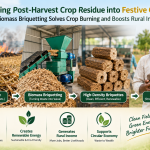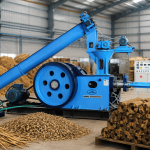
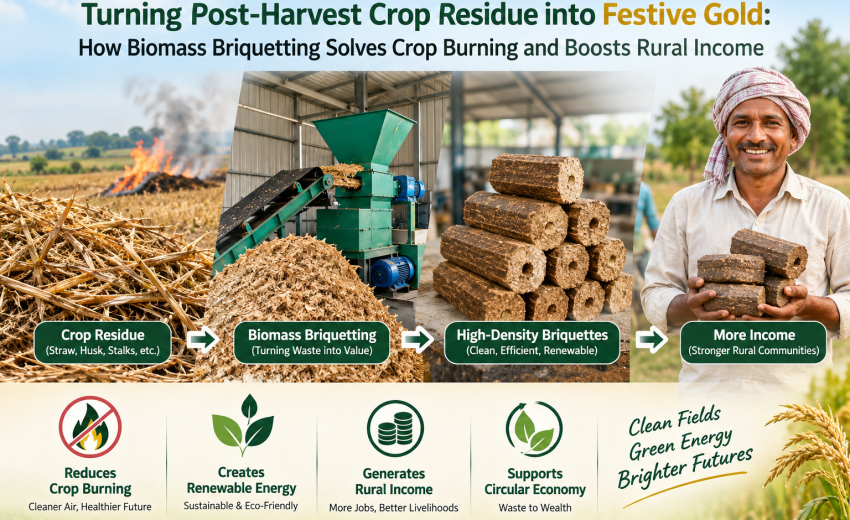
Post-harvest crop residue does not have to be burned or treated as waste. Biomass briquetting works simply: agricultural residues such as straw, stalks, husks, shells, and other dry biomass are processed, dried, sized, and compressed under high pressure into dense fuel briquettes. These briquettes can then be supplied to industries and other users that need solid biomass fuel.
For biomass business owners, this creates a practical opportunity to connect crop residue management, renewable fuel production, and rural income generation. In agricultural regions around Rajkot, India, organized collection and processing of suitable crop residues can turn an underused resource into a commercial raw material.
India’s Ministry of New and Renewable Energy (MNRE) has recognized biomass briquette and pellet manufacturing as part of its biomass-energy framework. At the same time, ICAR has identified briquetting and other ex-situ technologies as options for utilizing agricultural residues instead of burning them.
How does biomass briquetting work?
The basic biomass briquetting process converts loose agricultural waste into a compact, easier-to-handle solid fuel.
The typical process involves:
- Raw-material collection – Crop residues are collected from farms, storage areas, or agricultural processing operations.
- Sorting and cleaning – Soil, stones, metal, and unsuitable materials are removed.
- Size reduction – Large stalks or other residues may be chopped or crushed to achieve suitable particle size.
- Drying – Excess moisture is reduced because moisture content affects feeding, compression, briquette quality, and combustion.
- Feeding – Prepared biomass is supplied to the briquetting machine.
- Compression – Mechanical pressure densifies the biomass into briquettes.
- Cooling and handling – Fresh briquettes are allowed to stabilize before being stored or transported.
- Storage and dispatch – Finished briquettes are protected from moisture and supplied to customers.
The exact process and equipment configuration depend on the feedstock, moisture level, particle size, machine design, production capacity, and required briquette specifications.
What agricultural residues can be used?
Potential feedstocks include:
- Rice husk and rice straw
- Wheat straw
- Cotton stalks
- Groundnut shells
- Sawdust and wood-processing residues
- Maize residues
- Mustard stalks
- Soybean residues
- Other suitable dry agricultural biomass
Not every residue is automatically suitable. A feasibility assessment should consider availability, moisture, ash content, particle characteristics, seasonal supply, transportation distance, and the buyer’s fuel requirements.
Why is crop residue burning a problem?
Farmers may burn crop residues because they need to clear fields quickly between harvesting one crop and planting another. ICAR notes that a narrow harvesting-to-sowing window, mechanized harvesting, and labor shortages can contribute to residue burning.
Crop burning can result in:
- Smoke and particulate emissions
- Loss of potentially useful biomass
- Loss of nutrients contained in the residue
- Reduced opportunities for value-added residue utilization
- Local air-quality problems
ICAR has also highlighted the environmental and agricultural concerns associated with residue burning and the need for practical residue-management technologies.
This is where biomass briquetting can provide an ex-situ utilization route: instead of leaving suitable residue to be burned, it can be collected and processed into a marketable solid biofuel.
How can farmers turn crop residue into money?
One of the biggest opportunities is to treat crop residue as a saleable raw material instead of waste.
Farmers can potentially earn from agricultural residues by:
- Selling suitable crop residue to briquette manufacturers
- Supplying organized biomass collection networks
- Participating in farmer groups or cooperatives
- Establishing small-scale biomass aggregation operations
- Investing in a biomass briquetting business where economically viable
- Supplying consistent quantities to nearby biomass-fuel buyers
The actual income depends on residue type, quantity, moisture, collection costs, transportation, local market prices, and contractual terms.
MNRE’s biomass programme has explicitly identified the utilization of surplus agricultural residue as a way to reduce stubble burning and provide an additional income source to farmers through the sale of surplus agro-residue.
How to make money from agricultural waste
Making money from agricultural waste requires more than simply collecting crop residue. A commercially viable model needs a reliable supply chain.
A biomass business owner should evaluate:
Factor | Why it matters |
Feedstock availability | Determines whether the plant can operate consistently |
Moisture content | Influences processing and fuel quality |
Collection distance | Directly affects logistics costs |
Transportation | Loose biomass can be expensive to move |
Storage | Protects raw material from moisture and deterioration |
Machine capacity | Determines potential production volume |
Buyer demand | Provides the market for finished briquettes |
Fuel specifications | Buyers may require specific quality parameters |
Seasonal supply | Crop residues may be available at different times |
Operating costs | Determines overall business economics |
The goal is to build a reliable chain from farm → collection → processing → briquetting → storage → customer.
How do biomass briquettes increase farmer income?
Biomass briquettes can increase farmer income indirectly by creating a market for residues that previously had limited commercial value.
For example, consider a farming area where large quantities of crop residue are generated after harvesting. If there is a nearby biomass briquetting plant, the residue can potentially move through an organized collection system rather than being burned or left unused.
This can create several income channels:
1. Residue sales
Farmers can sell eligible crop residues to aggregators or briquette producers.
2. Collection and transportation work
Local businesses can develop services for baling, loading, transporting, sorting, and storing biomass.
3. Processing businesses
Entrepreneurs can establish biomass processing or briquetting operations where feedstock and market conditions support the investment.
4. Rural employment
A biomass supply chain requires people for collection, handling, transportation, equipment operation, maintenance, and administration.
ICAR has also documented biomass-briquette applications that can support rural employment and increase farm income through biomass utilization.
What is the biomass briquetting business opportunity for farmers?
A biomass briquetting business for farmers can be considered at different scales.
A farmer may simply sell residues. A group of farmers can collectively aggregate biomass. An entrepreneur can establish a processing unit. A larger business can operate a complete briquetting plant with contracted feedstock suppliers and industrial customers.
Before investing, business owners should answer five questions:
- Is enough biomass available locally?
- Can the biomass be collected economically?
- Can the feedstock be stored safely?
- Is there consistent demand for briquettes?
- Can the plant operate at an economically viable utilization rate?
These questions are especially important because biomass is bulky before densification. Transportation and handling can significantly influence project economics.
How can biomass briquetting help rural areas?
The benefits extend beyond individual farmers.
A well-organized biomass supply chain can create rural income opportunities from agricultural waste through collection, transportation, processing, machine operation, maintenance, and fuel distribution.
The model supports a circular approach:
Agricultural production → Crop residue → Collection → Briquetting → Renewable solid fuel → Industrial energy use → Rural economic activity
This approach also supports the broader objective of converting agricultural waste into useful energy resources.
MNRE’s biomass programme has supported the development of biomass briquette and pellet manufacturing plants, while its broader bioenergy framework covers energy generation from agricultural wastes and residues.
What role can biomass briquetting play in Rajkot, India?
Rajkot, India has a strong industrial ecosystem and is surrounded by agricultural activity across the wider Saurashtra region. This combination can create opportunities for biomass businesses that can identify suitable local residues and connect them with reliable fuel demand.
For a business owner in or around Rajkot, the opportunity should be assessed locally rather than assuming that every crop residue will be profitable.
Important considerations include:
- Availability of agricultural residues
- Distance between farms and the plant
- Seasonal availability
- Local industrial fuel demand
- Transportation infrastructure
- Electricity and operating costs
- Storage requirements
- Briquette specifications required by customers
- Competition from other fuels
- Long-term supply agreements
A local feasibility study is essential before purchasing machinery or committing to a production capacity.
How can biomass business owners build a reliable supply chain?
A briquetting plant is only as strong as its raw-material supply.
Business owners should consider creating agreements with:
- Farmers
- Farmer Producer Organizations (FPOs)
- Agricultural cooperatives
- Biomass aggregators
- Local transport operators
- Agro-processing businesses
- Industrial fuel buyers
A structured procurement system can reduce the risk of feedstock shortages and improve production planning.
A practical supply-chain model
Step 1: Identify major crop residues in the target area.
Step 2: Estimate seasonal availability.
Step 3: Map farms and aggregation points.
Step 4: Test representative biomass samples.
Step 5: Calculate collection and transportation costs.
Step 6: Identify potential briquette customers.
Step 7: Match plant capacity with realistic feedstock availability.
Step 8: Establish quality-control procedures.
Step 9: Develop storage and dispatch systems.
Step 10: Monitor production cost and customer demand continuously.
What should businesses check before starting a briquetting plant?
Starting a briquetting plant requires more than buying a machine.
A proper feasibility assessment should cover:
- Feedstock survey
- Raw-material testing
- Production capacity
- Machinery selection
- Land and plant layout
- Electricity requirements
- Drying requirements
- Labor
- Storage
- Transportation
- Product quality
- Customer demand
- Capital investment
- Working capital
- Operating expenses
- Expected selling price
- Regulatory requirements
- Financial viability
Government programmes and incentives can also change over time. For example, MNRE’s current BioUrja information states that applications for certain biomass and waste-to-energy programmes had closed on December 31, 2025, and that new applications were stopped until further notice. Businesses should therefore verify the latest official scheme status before including any subsidy or financial assistance in their business plan.
How can Ronak Engineering support biomass briquetting projects?
For businesses evaluating biomass briquetting, Ronak Engineering can be positioned as a machinery and project-support partner for biomass processing requirements.
Before selecting equipment, a business should communicate its:
- Raw-material type
- Expected moisture range
- Available biomass quantity
- Required production capacity
- Desired briquette size
- Operating hours
- Available power supply
- Storage conditions
- Target customer requirements
The right machine configuration should be selected according to actual feedstock and production needs rather than simply choosing the largest available capacity.
For Rajkot, India businesses, working with an experienced local engineering and machinery partner can also make technical discussions, site planning, installation coordination, and after-sales support easier.
What are the key benefits of converting crop residue into briquettes?
The main benefits include:
- Reducing the need to burn suitable crop residues
- Creating a market for agricultural waste
- Producing a denser and easier-to-handle solid fuel
- Supporting renewable-energy utilization
- Creating rural collection and logistics opportunities
- Supporting additional farmer income
- Creating opportunities for biomass entrepreneurs
- Supplying an alternative solid fuel for suitable industrial applications
However, briquetting is not a universal solution for every residue or every location. The economics depend on feedstock characteristics, logistics, machinery, energy requirements, market demand, and operating conditions.
Conclusion
Post-harvest crop residue can be more than an agricultural disposal problem. With the right collection system, processing technology, and market, suitable residues can become a useful feedstock for biomass briquettes.
Understanding how biomass briquetting works helps biomass business owners see the complete opportunity: collect agricultural residue, prepare it properly, densify it into briquettes, and supply it to suitable customers.
For farmers, this can create an additional route for earning from surplus crop residue. For rural entrepreneurs, it can create opportunities in aggregation, transportation, processing, and fuel production. For industries, it can provide access to a locally sourced biomass fuel option.
The key is to build the business around real feedstock availability, realistic logistics, consistent product quality, and confirmed customer demand.
For businesses evaluating a project in Rajkot, India, a detailed local feasibility assessment should come before investment. With the right planning and machinery partner such as Ronak Engineering, agricultural residue can move from being a seasonal waste challenge toward becoming a commercially useful biomass resource.
Frequently Asked Questions
1. How does biomass briquetting work?
Biomass briquetting works by preparing suitable agricultural residues and mechanically compressing them into dense briquettes. The exact preparation process depends on the raw material, moisture, particle size, machine, and required product specifications.
2. How can farmers turn crop residue into money?
Farmers can potentially earn by selling suitable crop residues to biomass aggregators or briquette manufacturers. They may also participate in organized collection networks or, where economically feasible, invest in biomass processing.
3. How to make money from agricultural waste?
Agricultural waste can generate income through collection, aggregation, transportation, processing, briquette manufacturing, and sale of biomass fuel. Profitability depends on feedstock availability, logistics, processing costs, and customer demand.
4. How do biomass briquettes increase farmer income?
Biomass briquettes can create an additional market for agricultural residues. Farmers may receive income from surplus biomass that might otherwise have little commercial value, while collection and processing activities can create additional rural employment.
5. Can biomass briquetting completely stop crop burning?
Briquetting can be one part of a broader crop-residue-management strategy, but it cannot eliminate burning everywhere by itself. Feedstock availability, collection infrastructure, economics, competing residue uses, and local agricultural practices all influence whether residues can be commercially utilized. ICAR identifies several ex-situ and in-situ residue-management options, including briquetting, pellet production, biogas, Bio-CNG, composting, and residue-management machinery.