Quick answer: Biomass briquette machine efficiency depends heavily on the condition of the raw material before it enters the machine. Moisture content affects bonding, compression, drying requirements, and briquette strength, while particle size affects material flow, packing, density, and energy requirements. Keeping these two factors under control can improve biomass briquette machine efficiency, production consistency, and finished-briquette quality.
For biomass business owners in Rajkot, India, this is especially important because agricultural and industrial residues can vary significantly in moisture, size, density, and composition. Before investing in machinery or increasing production, businesses should understand how feedstock preparation influences the entire briquetting process.
What is biomass briquette technology?
Biomass briquette technology is the process of converting loose biomass residues into compact solid fuel by applying mechanical pressure. Agricultural residues, forestry waste, sawdust, and other biomass materials can be processed into denser fuel that is easier to handle, store, transport, and use.
The basic process generally includes:
- Raw material collection
- Removal of unwanted materials
- Size reduction
- Drying when required
- Screening or particle-size control
- Feeding into the briquetting machine
- Compression and densification
- Cooling and storage
The quality of the incoming feedstock can strongly influence the final product. Research reviews identify particle size, moisture content, pressure, compaction time, and feedstock composition among the important variables affecting briquette quality and production performance.
How does biomass briquetting technology work?
Biomass briquetting technology works by compressing prepared biomass under controlled mechanical conditions. The pressure reduces the volume of loose material and brings particles closer together. Depending on the feedstock and machine, natural components such as lignin can contribute to bonding.
The process is not simply about applying more pressure. The machine must receive material with suitable physical properties.
Two important questions should therefore be answered before production:
- Is the raw material too wet or too dry?
- Is the particle size suitable and reasonably consistent?
If either factor is poorly controlled, the machine may require more energy, produce inconsistent briquettes, or experience feeding and production problems.
A technical review of biomass briquetting reports that feedstock moisture, particle size and shape, and compression conditions are major determinants of briquette quality.
Why does raw material moisture affect briquette machine efficiency?
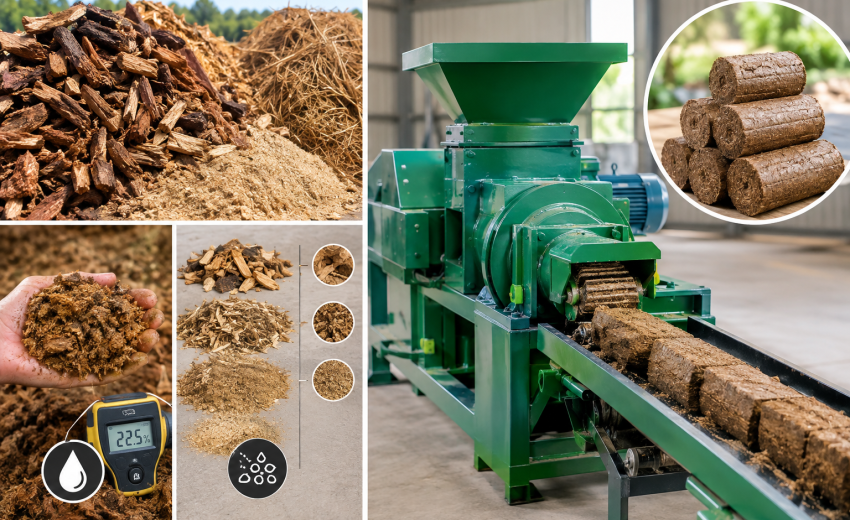
Moisture is one of the most important factors affecting briquette production. Water can influence particle bonding, friction, compression, density, drying requirements, and the final stability of the briquette.
A balanced biomass briquette moisture content is important because both excessive and insufficient moisture can create problems.
When biomass has too much moisture
High-moisture feedstock can create several challenges:
- More drying energy may be required.
- Excess moisture can interfere with effective compression.
- Steam formation can affect the briquetting process.
- Briquettes may have lower mechanical stability.
- Storage stability can become more difficult.
- Production consistency may decrease.
The FAO notes that moisture is a critical factor in briquetting and that excessive moisture can contribute to weak briquettes and operational problems in some briquetting systems.
When biomass is too dry
Very dry feedstock is not automatically better.
Moisture can assist contact and bonding between biomass particles. If the material is excessively dry, particle bonding may become less effective depending on the feedstock and machine technology.
This means that the goal is not simply to remove as much moisture as possible. The goal is to establish a moisture level suitable for the specific raw material and briquetting system.
What is the ideal moisture content?
There is no single moisture percentage that works for every biomass material and every machine.
Published research commonly reports useful operating ranges around 8–15% moisture, but the optimum varies according to feedstock, machine type, particle characteristics, and operating conditions. One major review notes that approximately 8–12% can be a generalized optimum for some densification applications, while other studies report different ranges for different technologies.
For this reason, biomass businesses should test their actual feedstock rather than applying one universal number.
How does particle size affect biomass briquette production?
Biomass particle size for briquetting affects how the material flows, packs, compresses, and bonds inside the machine.
Before briquetting, large pieces are commonly reduced using equipment such as crushers, chippers, grinders, or hammer mills.
Particle-size reduction can:
- Increase the available surface area between particles.
- Improve material packing.
- Support more consistent feeding.
- Reduce large voids within the briquette.
- Influence density and mechanical strength.
- Affect the energy required for preparation and compression.
A scientific review found that particle size or granulometry was one of the most frequently studied input variables in biomass briquette production.
Is smaller particle size always better?
No.
This is an important point for biomass business owners.
Very large particles may not pack efficiently, while extremely fine particles can increase grinding requirements and may create handling or flow problems. The ideal distribution depends on the raw material and the briquetting technology.
A balanced particle-size distribution can sometimes allow smaller particles to fill spaces between larger particles, improving packing.
FAO guidance also notes that a mixture of particle sizes can improve packing dynamics and contribute to product strength in certain briquetting systems.
What happens when moisture and particle size are not controlled?
Moisture and particle size do not work independently. They interact with other production variables such as pressure, temperature, feedstock composition, and machine design.
For example, a feedstock with:
- inconsistent moisture,
- oversized particles,
- excessive fines,
- high contamination,
- or inconsistent bulk density
can make machine operation less stable.
Potential symptoms include:
Problem | Possible feedstock-related cause |
Weak briquettes | Incorrect moisture or unsuitable particle distribution |
Cracked briquettes | Moisture imbalance or poor bonding |
Inconsistent density | Variable moisture, particle size, or feed rate |
High energy consumption | Excessive grinding or unsuitable feedstock condition |
Poor material flow | Excessive fines or inconsistent particle size |
Production variation | Changing moisture or raw-material composition |
Higher drying cost | Excessively wet feedstock |
Storage problems | Improper moisture control after production |
These symptoms should not automatically be blamed on the machine. Feedstock preparation should be checked first.
How can businesses improve briquette production efficiency?
Improving briquette production efficiency requires control over the entire feedstock preparation process rather than focusing only on the press.
1. Test incoming raw materials
Measure the moisture and physical condition of each major feedstock before processing.
Different materials can behave differently even when they come from the same agricultural region.
2. Use suitable size-reduction equipment
Choose a crusher, hammer mill, chipper, or other size-reduction system according to the material.
The objective is not simply to produce the smallest possible particles. The objective is to achieve a particle distribution suitable for stable briquetting.
3. Monitor moisture regularly
Do not depend only on visual inspection.
A moisture meter or appropriate laboratory testing method can provide more reliable information about feedstock conditions.
4. Keep the feedstock consistent
Sudden changes in raw material can affect production.
For example, switching from relatively dry sawdust to wetter agricultural residue can change the machine’s operating behavior.
5. Screen oversized and unwanted material
Screening can help remove oversized particles and unwanted contaminants before the material reaches the briquetting machine.
6. Record production results
Businesses should record:
- Raw material type
- Moisture content
- Particle size
- Production rate
- Power consumption
- Briquette density
- Briquette durability
- Machine operating conditions
Over time, these records can help identify the feedstock conditions that deliver the most consistent results.
How does feedstock preparation influence machine efficiency?
A briquetting machine can only perform consistently when the material entering it is properly prepared.
For example, Ronak Engineering’s current biomass machinery information states that its systems process agricultural and other biomass residues and include supporting equipment such as hammer mills, wood chippers, and flash air dryers. The company’s current site also notes that its machinery is designed around processing raw materials into controlled particle sizes before densification.
This shows why the briquetting machine should be considered as part of a complete biomass processing system, rather than an isolated piece of equipment.
For businesses in Rajkot, India, local availability of agricultural residues can be an advantage, but feedstock characteristics can change seasonally. A plant should therefore be designed around the actual materials available to the business.
What are the main factors affecting briquette production?
Moisture and particle size are important, but they are not the only variables.
The main factors affecting briquette production include:
- Moisture content – affects bonding, compression, and drying.
- Particle size – influences packing, feeding, and density.
- Particle-size distribution – affects how particles fill available spaces.
- Feedstock composition – lignin, fiber, and other components influence bonding.
- Bulk density – affects feeding and material handling.
- Compression pressure – influences densification and product density.
- Temperature – can influence natural binding components in some processes.
- Feed rate – affects production consistency.
- Raw-material contamination – can affect quality and machine operation.
- Machine design – different technologies have different feedstock requirements.
Research reviews consistently identify feedstock properties and operating parameters as important variables in biomass densification.
How can biomass businesses find the right operating conditions?
There is no single setting that should be copied from another biomass plant.
A better approach is to establish a feedstock testing and process-control routine.
Start with a representative sample and record:
- Material type
- Initial moisture
- Particle-size range
- Bulk density
- Ash content where relevant
- Machine model
- Production rate
- Power consumption
- Finished briquette density
- Durability and appearance
Then compare the results.
This approach helps a business understand the relationship between its raw material and machine performance.
For a machinery manufacturer such as Ronak Engineering, this type of feedstock information is also useful when discussing machine selection and plant configuration with a potential customer.
What should biomass business owners check before buying a machine?
Before selecting a biomass briquette machine, businesses should evaluate the complete production requirements.
Feedstock checklist
- What biomass is available?
- How much material is available per day?
- What is the average moisture content?
- What is the maximum raw-material size?
- How much size reduction is required?
- Does the feedstock change by season?
- Is drying equipment required?
Production checklist
- Required production capacity
- Desired briquette diameter
- Available electricity
- Available plant space
- Labour requirements
- Storage requirements
- Transportation requirements
- Maintenance and spare-parts availability
Ronak Engineering’s current product information provides machine specifications including capacity, power requirements, raw-material size and infrastructure requirements. These specifications should be considered alongside the actual feedstock characteristics of a proposed plant.
How does better feedstock control improve biomass briquette machine efficiency?
Better feedstock preparation can improve biomass briquette machine efficiency in several ways.
First, consistent material can support more stable feeding. Second, suitable particle size can improve packing and reduce unnecessary processing. Third, controlled moisture can reduce avoidable drying or compression problems.
The result is not necessarily a simple increase in kilograms per hour. True efficiency should be considered across the complete process.
A useful business-level view is:
Raw material quality → preparation → machine operation → briquette quality → storage → fuel performance
If one stage is poorly controlled, it can affect the next stage.
This is why biomass briquette machine efficiency should be measured using more than production capacity alone.
Why is this important for biomass businesses in Rajkot, India?
Rajkot, India, is an important industrial and agricultural region where businesses can explore biomass processing opportunities using locally available residues.
However, raw material availability does not automatically mean that every feedstock is suitable for identical processing conditions.
A biomass business should understand:
- Seasonal moisture changes
- Local agricultural residues
- Transport distance
- Raw-material storage
- Drying requirements
- Size-reduction requirements
- Expected production volume
For a business planning a new plant in Rajkot, India, feedstock testing before final machine selection can help reduce uncertainty and support better plant planning.
How can Ronak Engineering help with biomass briquetting?
Ronak Engineering manufactures biomass briquetting and related biomass-processing machinery, including briquetting machines, hammer mills, wood chippers, and flash air dryers.
Its current website states that its machinery is designed to process agricultural and other biomass residues and that the company provides complete production-line solutions. The company also lists technical information for its briquetting machines, including production capacity and raw-material requirements.
For businesses evaluating a biomass project, the machine should be selected according to the actual feedstock, required production rate, available infrastructure, and desired briquette specifications rather than capacity alone.
Key takeaways
The most important lessons about biomass briquette machine efficiency are:
- Moisture content has a major influence on briquetting performance.
- There is no universal moisture level for every biomass material.
- Particle size affects feeding, packing, density, and energy requirements.
- Smaller particles are not always automatically better.
- Consistent feedstock can support more stable production.
- Drying and size reduction should be considered part of the complete process.
- Machine selection should be based on actual feedstock characteristics.
- Production efficiency should include quality, energy use, and consistency—not only output per hour.
For biomass businesses in Rajkot, India, controlling these variables can provide a stronger foundation for reliable briquette production.
Frequently Asked Questions
1. What is biomass briquette machine efficiency?
Biomass briquette machine efficiency refers to how effectively a machine converts prepared biomass into consistent briquettes while managing production rate, energy consumption, material losses, and product quality.
2. What is the ideal biomass briquette moisture content?
The ideal moisture content varies by biomass type and machine technology. Research commonly reports useful ranges of 8–15%, but businesses should determine the right range through feedstock testing and machine-specific trials.
3. What is the best biomass particle size for briquetting?
There is no single best particle size for every feedstock or machine. Particle size should be selected according to the material, machine design, and desired briquette properties. A controlled particle-size distribution is generally more useful than simply grinding everything as fine as possible.
4. How does moisture affect briquette quality?
Moisture affects particle bonding, compression, density, drying requirements, and durability. Too much or too little moisture can negatively affect production, so the appropriate range should be determined for the specific feedstock and technology.
5. How can I improve biomass briquette machine efficiency?
Start by controlling raw-material moisture and particle size, maintaining consistent feedstock, removing contaminants, using suitable size-reduction and drying equipment, monitoring production data, and selecting a machine based on the actual characteristics of the biomass.