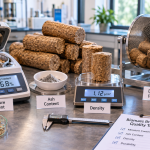
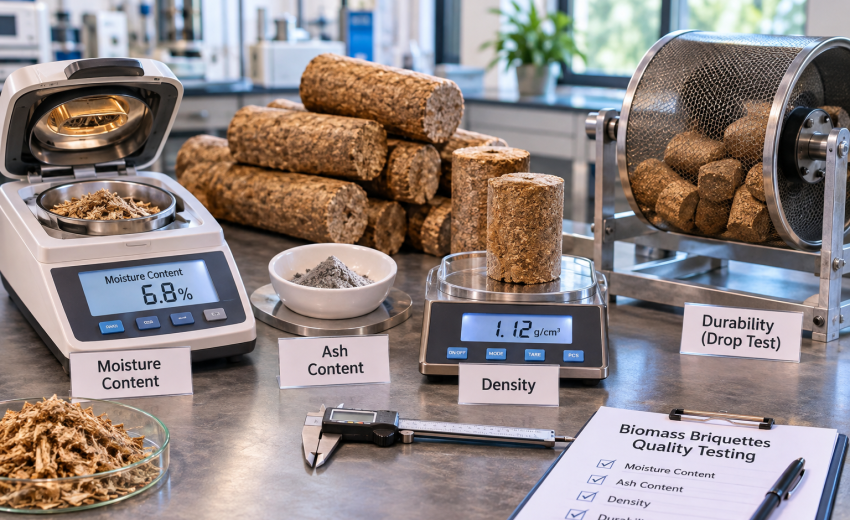
Biomass briquette quality testing helps manufacturers check whether their briquettes are suitable for storage, transportation, and industrial fuel applications. The four important parameters are moisture content, ash content, density, and durability. Testing these properties helps biomass business owners maintain consistent product quality, reduce material wastage, and improve fuel performance.
Biomass briquettes are manufactured using agricultural waste, wood residues, sawdust, groundnut shells, rice husk, and other organic materials. However, not all briquettes have the same quality. Their performance depends on the raw materials, particle size, moisture level, production conditions, and compression process.
What Is Biomass Briquettes Quality Testing?
Biomass briquettes quality testing is the process of checking the physical and fuel properties of briquettes to understand their quality, consistency, and suitability for different applications.
It helps manufacturers identify production problems before the finished products reach customers.
The main parameters checked during biomass briquette quality testing include:
Quality Parameter | What Does It Measure? | Why Is It Important? |
Moisture content | Amount of water present in briquettes | Affects combustion and storage |
Ash content | Non-combustible residue after burning | Helps evaluate fuel cleanliness |
Density | Mass per unit volume | Affects storage, handling, and energy per unit volume |
Durability | Resistance to breaking and abrasion | Helps reduce transportation losses |
Calorific value | Heat energy released during combustion | Helps evaluate fuel performance |
Regular testing allows manufacturers to compare production batches and maintain consistent quality.
Why Is Moisture Content Important in Biomass Briquettes?
Moisture content is one of the most important factors in biomass briquette production. It indicates how much water is present in the finished briquette.
Excess moisture can reduce the useful heat available during combustion because some energy is used to evaporate the water. It can also create storage problems and affect briquette strength.
How to measure moisture content in biomass briquettes?
Manufacturers can measure moisture content using a moisture analyser or a laboratory oven-drying method.
A basic oven-drying method involves these steps:
- Collect a representative sample of finished briquettes.
- Weigh the sample before drying and record its initial weight.
- Place the sample in a suitable laboratory drying oven.
- Dry it using the temperature and procedure specified by the selected testing standard.
- Cool the sample in a desiccator and weigh it again.
- Calculate the moisture percentage.
Moisture content formula:
Moisture Content (%) = [(Initial Weight − Dry Weight) ÷ Initial Weight] × 100
Example:
Suppose a biomass briquette sample weighs 100 grams before drying and 92 grams after drying.
Moisture Content = [(100 − 92) ÷ 100] × 100
Moisture Content = 8%
This means the sample contains 8% moisture on a wet basis.
How does moisture affect briquette quality?
- High moisture can reduce effective heat output.
- Excess water can affect briquette storage stability.
- Improper moisture levels can create production difficulties.
- Suitable moisture conditions help maintain consistent briquette quality.
The ideal moisture level depends on the raw material, machine design, intended fuel application, and customer specifications. Manufacturers should follow the applicable testing standard rather than using one value for every type of biomass.
What Is Ash Content and Why Should Manufacturers Test It?
Ash content refers to the non-combustible residue remaining after biomass briquettes are completely burned under specified laboratory conditions.
It is an important parameter because higher ash content means a larger portion of the fuel remains as residue instead of contributing useful heat.
How is ash content measured?
Ash content is generally measured through a laboratory furnace test.
The basic procedure includes:
- Take a representative biomass briquette sample.
- Prepare and weigh the sample according to the selected testing method.
- Place it in a pre-weighed crucible.
- Heat it in a laboratory muffle furnace using the specified test conditions.
- Allow the ash residue to cool in a desiccator.
- Weigh the remaining ash and calculate its percentage.
Ash Content Formula:
Ash Content (%) = (Weight of Ash ÷ Initial Dry Sample Weight) × 100
Example:
If the dry sample weighs 10 grams and the remaining ash weighs 1 gram:
Ash Content = (1 ÷ 10) × 100
Ash Content = 10%
This means the sample has 10% ash content on a dry basis.
What factors affect ash content?
Several factors can influence the ash content of biomass briquettes:
- Type of agricultural waste used
- Soil and sand contamination
- Raw material cleaning methods
- Mineral content of the biomass
- Processing and handling conditions
For example, agricultural residues collected directly from fields may contain soil or sand. Proper raw material cleaning can help reduce unwanted contamination.
Lower ash content may be preferred for certain industrial applications, but the acceptable level depends on the fuel specification and the equipment using it.
What Is Biomass Briquette Density and How Is It Tested?
Biomass briquette density refers to the mass of a briquette compared with the volume it occupies.
Density is an important physical property because it influences storage, transportation, handling, and energy content per unit volume.
A properly compacted briquette generally has a more uniform structure than loose biomass material. However, density alone does not guarantee good fuel performance.
How to calculate biomass briquette density?
Density can be calculated using the following formula:
Density = Mass ÷ Volume
For a cylindrical briquette, volume can be calculated as:
Volume = π × Radius² × Length
Example:
Suppose a cylindrical biomass briquette has:
- Mass: 100 grams
- Radius: 2 cm
- Length: 10 cm
Volume = 3.1416 × 2² × 10
Volume = 125.66 cm³
Density = 100 ÷ 125.66
Density = 0.796 g/cm³ approximately.
This is the estimated density of the briquette.
Why is density important?
- Helps evaluate the effectiveness of material compression.
- Supports better storage and transportation planning.
- Helps maintain consistent briquette dimensions and weight.
- Influences the amount of fuel that can fit into a given storage volume.
- Helps manufacturers compare different production batches.
The density requirement should be selected according to the raw material, briquette dimensions, production method, and customer requirements.
How to Perform a Biomass Briquette Durability Test?
Biomass briquette durability refers to the ability of a briquette to maintain its shape and structure during handling, loading, unloading, and transportation.
Briquettes with poor durability can break into smaller pieces, creating dust and material losses.
A biomass briquette durability test helps manufacturers understand how well their products resist physical damage.
How to test the durability of biomass briquettes?
A standardized tumbling or abrasion test can be used to measure briquette durability.
The general procedure involves:
- Collect a representative sample of finished briquettes.
- Separate and weigh the test sample according to the selected method.
- Place the sample in a suitable durability testing device.
- Rotate or tumble the sample under controlled conditions.
- Remove the sample and separate the broken particles using the specified sieve.
- Weigh the remaining intact briquettes.
- Calculate the durability percentage.
Durability Formula:
Durability (%) = (Weight of Intact Briquettes After Testing ÷ Initial Sample Weight) × 100
Example:
If the initial sample weighs 1,000 grams and the intact briquettes weigh 950 grams after testing:
Durability = (950 ÷ 1,000) × 100
Durability = 95%
This indicates that 95% of the original sample mass remained intact under the selected test conditions.
What causes low briquette durability?
Common reasons include:
- Incorrect raw material moisture
- Uneven particle size
- Insufficient compression
- Poor raw material preparation
- Improper machine settings
- Inconsistent feeding
- Incorrect cooling and handling practices
Manufacturers should investigate these factors when they observe frequent briquette breakage.
What Is Biomass Briquette Performance Testing?
Biomass briquette performance testing evaluates how the finished fuel behaves during actual use. It goes beyond physical appearance and checks important fuel properties.
The main tests include:
Test | What Does It Evaluate? |
Calorific value test | Heat energy released by the fuel |
Moisture test | Water content in the briquettes |
Ash test | Non-combustible residue |
Volatile matter test | Compounds released during heating under specified conditions |
Fixed carbon test | Estimated solid combustible fraction |
Durability test | Resistance to physical damage |
Density test | Mass per unit volume |
These tests help manufacturers understand whether their products meet the requirements of industrial buyers.
For example, a boiler operator may consider calorific value, moisture, ash content, and fuel consistency before selecting a biomass briquette supplier.
What Are the Important Biomass Briquette Quality Standards?
Biomass briquette quality standards provide guidelines for evaluating fuel properties and maintaining consistency between production batches.
Manufacturers should identify the relevant standard based on their product type, market, and intended application.
Some useful international testing references include:
- ISO 18134 series: Methods for determining moisture content in solid biofuels.
- ISO 18122: Method for determining ash content in solid biofuels.
- ISO 17828: Method for determining bulk density of solid biofuels.
- ISO 17831-2: Method for determining mechanical durability of non-woody pellets.
- ISO 18125: Method for determining calorific value of solid biofuels.
These standards cover specific testing methods. Their suitability should be checked for the particular briquette type because pellet and briquette testing requirements are not always interchangeable.
For biomass business owners in Rajkot, India, it is important to agree on quality specifications with buyers and use consistent laboratory testing procedures.
How Can Manufacturers Improve Biomass Briquette Quality?
Maintaining consistent quality requires attention to every stage of the manufacturing process, from raw material selection to finished product storage.
Here are practical ways to improve biomass briquette quality:
1. Select suitable raw materials
Use clean and suitable biomass materials. Avoid excessive soil, stones, and other unwanted contaminants.
2. Maintain proper moisture levels
Check raw material moisture before processing. Use a suitable drying system when excess moisture is present.
3. Maintain uniform particle size
Proper crushing and grinding help create more consistent material for the briquetting process.
4. Check machine settings
Maintain suitable operating conditions and inspect the briquetting machine regularly to avoid inconsistent compression.
5. Allow proper cooling
Freshly produced briquettes should be cooled appropriately before packaging and storage.
6. Test every production batch
Regularly check moisture, ash content, density, and durability. Keep records to identify changes in production quality.
7. Store finished briquettes correctly
Store briquettes in a clean, dry, and well-ventilated area. Protect them from rain and excess moisture.
Why Is Quality Testing Important for Biomass Business Owners?
For biomass manufacturers, quality testing is not just a laboratory activity. It is an important part of production management and customer satisfaction.
Regular testing provides several business benefits:
- Consistent product quality: Helps maintain similar fuel properties across production batches.
- Reduced material wastage: Identifies weak briquettes and production problems early.
- Better customer confidence: Provides test results that buyers can use when evaluating fuel.
- Improved production control: Helps manufacturers understand the effect of raw materials and machine settings.
- Better storage and transportation: Helps reduce losses caused by breakage and moisture exposure.
- Informed business decisions: Supports improvements in raw material selection and manufacturing methods.
For manufacturers in Rajkot, India, these practices can help build stronger relationships with industrial customers and improve production management.
Why Choose Ronak Engineering for Biomass Processing Machinery?
Choosing suitable machinery is an important step in producing consistent biomass briquettes. The quality of the final product depends on several factors, including raw material preparation, particle size, moisture control, and compression.
Ronak Engineering provides biomass processing and machinery solutions for businesses involved in briquette and pellet production.
When planning a biomass manufacturing setup, business owners should consider:
- Suitable crushing and grinding equipment
- Appropriate biomass drying solutions
- Briquetting machine specifications
- Required production capacity
- Raw material compatibility
- Machinery maintenance and technical support
Ronak Engineering aims to help biomass businesses understand their processing requirements and select machinery according to their production needs.
Whether you are establishing a new biomass production unit or improving an existing facility, proper machinery selection and regular quality testing can help maintain consistent manufacturing performance.
Conclusion
Biomass briquettes quality testing is essential for manufacturers who want to produce reliable fuel for industrial applications. Moisture content, ash content, density, and durability are four important parameters that help evaluate the physical and fuel properties of finished briquettes.
For biomass business owners in Rajkot, India, understanding these testing methods can support better production decisions and long-term business growth. By combining suitable machinery, proper raw material preparation, and regular quality checks, manufacturers can build a more reliable biomass briquette production process.
For suitable biomass processing machinery and production solutions, connect with Ronak Engineering.
Frequently Asked Questions About Biomass Briquettes Quality Testing
1. What are the main parameters used in biomass briquettes quality testing?
The main parameters are moisture content, ash content, density, durability, calorific value, volatile matter, and fixed carbon. These tests help evaluate fuel quality and physical performance.
2. How to measure moisture content in biomass briquettes?
Moisture can be measured using a moisture analyser or an oven-drying method. The sample is weighed before and after drying, and the difference is used to calculate its moisture percentage.
3. How to test the durability of biomass briquettes?
Durability can be tested using a standardized tumbling or abrasion method. The briquettes are subjected to controlled physical movement, and the remaining intact material is weighed to calculate durability.
4. Why is biomass briquette density important?
Biomass briquette density helps determine how compact the fuel is. It affects storage, transportation, handling, and the amount of fuel that can be stored in a given volume.
5. Which quality standards are used for biomass briquettes?
International solid biofuel testing references include ISO 18134 for moisture, ISO 18122 for ash, ISO 17828 for bulk density, and applicable durability methods based on fuel type. The correct method depends on the product being tested.