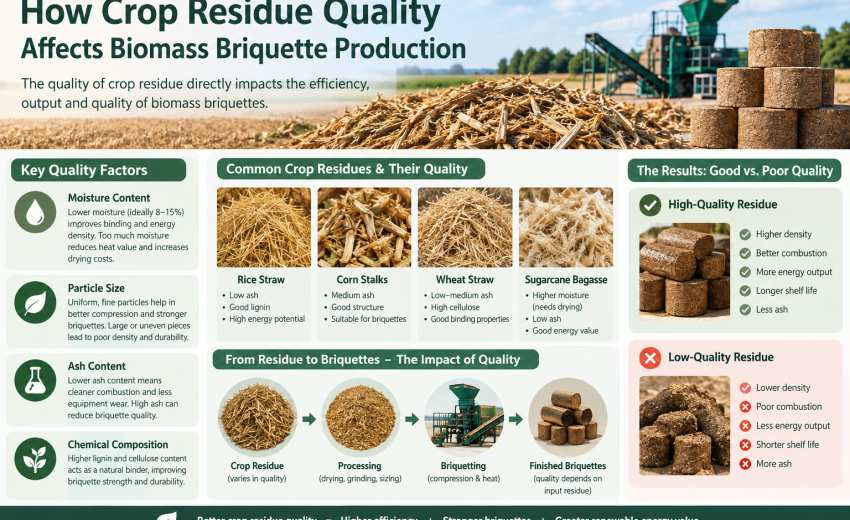
Crop residue quality matters for biomass briquette production because raw material quality directly affects briquette strength, density, moisture, durability, handling, and combustion performance. Crop residues such as rice straw, wheat straw, cotton stalks, groundnut shells, sugarcane residues, corn residues, and other agricultural wastes can be converted into useful solid fuel. Still, they do not all behave the same way during briquetting.
Key factors include moisture content, particle size, ash content, bulk density, fiber structure, contamination, and raw material consistency. Proper drying, size reduction, screening, and feedstock testing can help create a more stable briquetting process.
For biomass businesses in Rajkot, India, understanding these factors can help reduce production problems and improve the consistency of finished briquettes.
What is crop residue quality for biomass briquettes?
Crop residue quality for biomass briquettes refers to the physical and chemical characteristics of agricultural waste before it enters the briquetting machine.
Good-quality raw material should be reasonably clean, consistent, properly sized, and within a suitable moisture range for the selected briquetting technology.
Important characteristics include:
- Moisture content
- Particle size and distribution
- Ash content
- Bulk density
- Fiber structure
- Calorific value
- Foreign material and contamination
- Storage condition
- Feedstock consistency
FAO resources explain that agricultural residues can be suitable feedstocks for solid biofuels such as briquettes and pellets, while the specific characteristics of the material need to be considered when selecting and operating a briquetting process.
How does crop residue quality affect briquette production?
How crop residue quality affects briquette production can be understood by looking at how raw material behaves during drying, grinding, feeding, compression, cooling, storage, and combustion.
Poor-quality or inconsistent feedstock can cause:
- Uneven feeding
- Machine blockages
- Weak briquettes
- Cracking
- Low density
- Higher production losses
- Inconsistent fuel performance
- Greater ash-related problems
On the other hand, properly prepared biomass can provide more consistent production and easier quality control.
1. Moisture content
Moisture is one of the most important factors in biomass briquetting.
If the feedstock contains too much water, compression can become difficult. Excess moisture can also generate steam during the process and may contribute to weak briquettes, cracks, swelling, or operational problems.
FAO technical guidance reports that, for a screw-extrusion process, feed moisture around 8–10% has produced briquettes with approximately 6–8% moisture under the described operating conditions. It also notes that higher moisture can make the operation erratic.
This does not mean that 8–10% is a universal setting for every machine or crop residue. The appropriate range depends on the feedstock, machine design, pressure, temperature, and operating conditions.
How moisture content affects biomass briquette quality
How moisture content affects biomass briquette quality is mainly related to compaction and bonding.
Too much moisture may:
- Reduce effective compression
- Create excess steam
- Reduce apparent density
- Increase cracking or swelling
- Make feeding less consistent
Very dry material can also behave differently because a small amount of moisture can support particle bonding in lignocellulosic biomass. FAO notes that water can contribute to bonding between particles during compaction.
For this reason, biomass producers should measure moisture instead of relying only on visual inspection.
Why is particle size important in biomass briquette production?
Particle size affects how biomass particles pack together inside the compression chamber.
Very large particles may create gaps and make uniform compaction difficult. Extremely fine material can also create feeding and flow problems for some machines.
FAO guidance notes that a mixture of particle sizes can improve packing because smaller particles can occupy spaces between larger particles.
A practical preparation process may include:
- Collecting and sorting the residue.
- Removing stones, metal, soil, and other contaminants.
- Chopping or shredding oversized material.
- Grinding the material when required.
- Screening to achieve a more consistent feed.
- Adjusting moisture before briquetting.
The exact particle-size requirement should be established according to the raw material and briquetting machine being used rather than applying one number to every biomass type.
How does ash content affect biomass briquette quality?
Ash is the inorganic material left after biomass is burned.
Different agricultural residues can have very different ash levels. Soil, sand, and other contamination can also increase the ash content of a feedstock.
High ash can affect:
- Combustion performance
- Residue generation
- Furnace or boiler operation
- Ash handling requirements
- Slagging and fouling risks in some applications
A recent review indexed by FAO AGRIS highlights moisture and ash as important factors affecting briquette performance and discusses the impact of high-ash agricultural materials on thermal performance.
Therefore, biomass business owners should test new feedstocks instead of assuming that all crop residues will produce the same fuel quality.
Which crop residue characteristics matter most?
The following table gives a practical overview:
Crop residue characteristic | Effect on briquette production | What producers should check |
Moisture | Influences compaction, density, and stability | Measure before production |
Particle size | Affects packing and feeding | Grind, chop, and screen |
Ash content | Affects combustion and residue | Test representative samples |
Bulk density | Influences feeding and storage | Monitor consistency |
Fiber structure | Affects bonding and compression | Test each feedstock |
Contamination | Can damage equipment and affect ash | Remove foreign materials |
Storage condition | Can change moisture and quality | Keep biomass dry and protected |
Feedstock consistency | Affects production stability | Maintain regular sourcing |
How should biomass raw material be prepared before briquetting?
Biomass briquette raw material quality can be improved through a controlled preparation process.
Step 1: Select suitable agricultural residues
Identify residues that are available in sufficient quantity and can be collected economically.
Possible materials include:
- Rice straw
- Wheat straw
- Cotton stalks
- Groundnut shells
- Corn residues
- Sugarcane residues
- Sawdust and other suitable biomass residues
The suitability of a material should be confirmed through testing because different residues have different physical and chemical characteristics.
Step 2: Remove contaminants
Remove stones, soil, metals, plastic, and other unwanted materials.
This protects equipment and improves the consistency of the feedstock.
Step 3: Check moisture
Measure moisture from representative samples. Do not assume that recently collected biomass has a consistent moisture level.
Drying may be necessary when moisture is too high.
Step 4: Reduce particle size
Use suitable chopping, shredding, or grinding equipment according to the material and briquetting technology.
The objective is a feedstock that can flow and compress consistently.
Step 5: Screen the material
Screening helps remove oversized particles and improve feed consistency.
A consistent feed can make process control easier.
Step 6: Test the prepared biomass
For commercial production, consider testing:
- Moisture
- Ash
- Bulk density
- Calorific value
- Particle-size distribution
Testing gives the operator better information for setting machine conditions.
What happens when agricultural residue quality is inconsistent?
Inconsistent agricultural residue can create production variations even when the briquetting machine is operating correctly.
For example, a production batch may contain dry material in the morning and wetter material later because of different storage conditions. Another batch may contain more soil or fine particles than the previous one.
This can change how the material feeds and compresses.
A useful approach is to create a raw-material quality checklist:
- Feedstock type identified
- Moisture measured
- Contamination checked
- Particle size checked
- Ash content tested when required
- Storage condition recorded
- Feedstock source recorded
- Production results compared
This type of basic quality control can help biomass businesses identify the reason for changes in briquette performance.
Can different crop residues be mixed for briquette production?
Yes, different biomass materials can sometimes be blended, but the blend should be tested before commercial production.
Different residues can have different:
- Moisture levels
- Particle sizes
- Ash contents
- Fiber structures
- Bulk densities
- Combustion characteristics
Research on co-briquetting has found that biomass composition can significantly influence the physical and fuel characteristics of the resulting briquettes.
For a new blend, producers should start with controlled trials and compare density, durability, moisture, ash, and combustion performance.
What should biomass business owners check before buying raw material?
Before purchasing large quantities of agricultural residues, business owners should evaluate both quality and supply reliability.
Consider these questions:
- Is the residue available throughout the production season?
- What is the average moisture content?
- Does the moisture vary between suppliers?
- Is the material contaminated with soil or stones?
- What is the particle size?
- What is the ash content?
- How much usable material is available?
- Can the material be stored safely?
- What transportation cost is involved?
- Does the material produce acceptable briquettes during a trial?
For businesses in Rajkot, India, local availability, seasonal supply, transportation distance, and storage conditions can all influence the practical cost of biomass briquette production.
How can Ronak Engineering help with biomass briquetting?
Ronak Engineering focuses on biomass processing and briquetting equipment for businesses working with agricultural and biomass residues.
When selecting or operating a briquetting system, the machine should be considered together with the raw material. A machine cannot completely compensate for unsuitable or highly inconsistent feedstock.
Business owners should therefore evaluate:
- Feedstock type
- Required production capacity
- Moisture preparation
- Size-reduction requirements
- Feeding system
- Briquetting technology
- Finished briquette specifications
- Storage and handling requirements
A proper feedstock trial before large-scale production can help determine whether the selected biomass and machine settings are suitable.
What are the key takeaways about crop residue quality?
The main lesson is simple: good briquettes start with properly prepared biomass.
Crop residue quality affects the entire production chain, from feeding and compression to finished briquette storage and combustion.
For consistent production:
- Control moisture.
- Maintain suitable particle size.
- Remove contaminants.
- Monitor ash content.
- Keep feedstock consistent.
- Store biomass under suitable conditions.
- Test new materials before large-scale production.
- Match the raw material with the briquetting technology.
FAO documentation also emphasizes that biomass characteristics and process conditions need to be considered when evaluating and operating briquetting systems.
Conclusion
How crop residue quality affects biomass briquette production is not only a technical question but also an important business consideration. Moisture, particle size, ash, contamination, fiber structure, and feedstock consistency can all influence the production process and final briquette characteristics.
For biomass business owners, the best approach is to test the available crop residue, prepare it properly, and match the feedstock with the right briquetting equipment and operating conditions. This approach can support more consistent production and help businesses make better decisions about raw material sourcing and processing.
For companies evaluating biomass processing solutions in Rajkot, India, proper feedstock assessment should be an important part of planning a briquetting project.
Frequently Asked Questions
1. Why is crop residue quality important for biomass briquettes?
Crop residue quality affects moisture, feeding, compaction, density, durability, ash generation, and combustion performance. Consistent raw material makes process control easier.
2. How does moisture content affect biomass briquette quality?
Moisture affects particle bonding, compression, density, and briquette stability. Excess moisture can create steam and operational problems, while the correct range depends on the biomass and machine.
3. Which crop residues can be used for biomass briquettes?
Suitable materials can include rice straw, wheat straw, cotton stalks, groundnut shells, corn residues, sugarcane residues, and other suitable agricultural biomass. Each material should be tested before commercial production.
4. Does particle size affect briquette strength?
Yes. Particle size affects packing and compression. A suitable and reasonably consistent particle-size distribution can improve feeding and compaction, although the ideal size depends on the feedstock and machine.
5. How can biomass business owners improve raw material quality?
They can improve feedstock quality by removing contaminants, controlling moisture, reducing oversized particles, screening the material, testing ash and other properties, and maintaining consistent storage and sourcing practices.