If you’re searching for the best agricultural waste for biomass briquettes, the short answer is this: cotton stalks, groundnut shells, wheat straw, sugarcane bagasse, and rice husk are the top five agro-residues used for making high-density fuel briquettes. Each one offers a different mix of calorific value, availability, and processing cost, which is why choosing the right blend matters for briquette manufacturers in Rajkot and across Gujarat.
Rajkot is the central point of one of the most productive agricultural regions in India, dotted with cotton, groundnut, and wheat fields. This makes it an ideal place to turn agro-residues into a steady income stream rather than letting them rot or burn in the fields. This article will highlight the five best agro-residues for briquette production, explain how to choose the best option for your briquetting business, and discuss what to consider while setting up a briquetting unit.
What is agricultural waste for biomass briquettes?
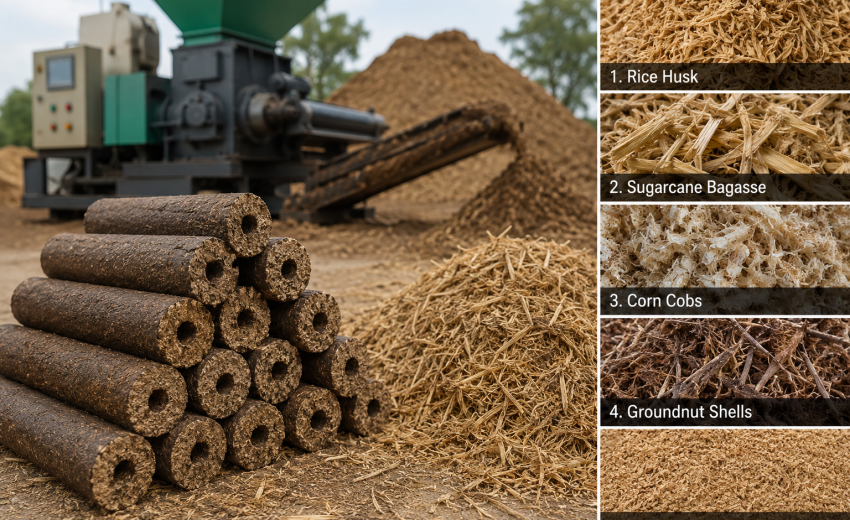
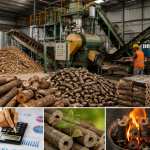
Agricultural waste for biomass briquettes is any plant matter obtained as a by-product of farming, such as stalks, husks, shells, straw, and stubble, which are typically burned or discarded after harvest. Instead, they can be collected, dried, crushed, and compacted under high pressure into dense cylindrical ingots. These ingots are then used as fuel in boilers and other combustion units to replace more traditional fuels such as coal or firewood.
To a farmer who has turned to biomass fuel production, such wastes are not wastes at all but potential sources of profit. The main challenge in choosing what to use for biomass briquetting is identifying which agricultural wastes for briquetting are worth pursuing from an economic perspective.
Top 5 agro-residues for high-density briquettes
Here’s a closer look at the agricultural waste used for briquettes that consistently perform best in terms of density, burn time, and heat output.
1. Cotton stalks
Cotton stalks are widely available around Rajkot and Saurashtra thanks to the region’s strong cotton farming base. They have a decent calorific value (around 4,000–4,500 kcal/kg) and produce briquettes with good structural strength. Because cotton stalks are fibrous, they bind well under compression, which reduces the need for extra binding agents.
2. Groundnut shells
Groundnut shells are another local favorite, especially since Saurashtra is a major groundnut-producing region. Shells are low in moisture, easy to store, and produce briquettes with a clean, steady burn. They’re often blended with other residues to balance density and ash content.
3. Wheat straw
Wheat straw is lightweight and abundant right after the rabi harvest. On its own, it can be tricky to compress into high-density briquettes because of its low bulk density, so it’s usually mixed with denser residues like groundnut shells or cotton stalks for better output quality.
4. Sugarcane bagasse
Bagasse — the fibrous leftover after crushing sugarcane for juice — is a reliable option in regions with sugar mills nearby. It has a moderate calorific value and works well when dried properly before briquetting. Its consistent supply from mills makes it easier to plan production around.
5. Rice husk
Rice husk is one of the most commonly used residues nationwide because it’s available in large volumes and burns efficiently. It has a slightly higher ash content than some other residues, but its wide availability and low cost make it a dependable choice, especially when blended with other materials.
Which agricultural waste is best for making briquettes?
There’s no single “best” residue — it depends on what’s available near your unit and what fuel quality your buyers need. That said, a quick comparison helps:
Agro-residue | Calorific value (kcal/kg) | Availability near Rajkot | Ease of briquetting |
Cotton stalks | 4,000–4,500 | High | Good |
Groundnut shells | 4,200–4,700 | High | Good |
Wheat straw | 3,500–4,000 | Seasonal | Moderate |
Sugarcane bagasse | 3,800–4,200 | Moderate | Good |
Rice husk | 3,000–3,500 | High | Moderate |
How to convert agricultural waste into fuel briquettes
Turning raw residue into a sellable product follows a fairly consistent process, regardless of which agro-residue you’re using:
- Collection – Gather residue from farms or agro-processing units soon after harvest.
- Drying – Reduce moisture content to below 12–15% for efficient compression.
- Size reduction – Grind or shred the material into a uniform particle size.
- Compression – Feed the material into a briquetting press, where high pressure (and often heat) binds it into dense logs without added chemicals.
- Cooling and packaging – Let briquettes cool and harden before storage or dispatch.
Getting consistent quality at this stage depends heavily on the machinery used. This is where working with an experienced manufacturer makes a real difference in output consistency and machine uptime.
Why Rajkot is a strong base for briquette manufacturing
Rajkot’s location gives biomass business owners a practical edge. The city sits close to cotton belts, groundnut farms, and agro-processing units, which means shorter transport distances and lower raw material costs. Rajkot’s manufacturing ecosystem also supports easy access to briquetting machinery, spare parts, and technical service — all useful when you’re scaling up production.
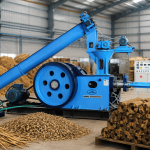
This is exactly the gap Ronakeng fills for biomass entrepreneurs. As a briquetting machine manufacturer based in Rajkot, Ronakeng builds equipment designed to handle a range of agro-residues, from fibrous cotton stalks to fine rice husk, without constant breakdowns or quality drops. For business owners weighing which machine setup suits their raw material mix, Ronakeng’s team in Rajkot can help match equipment capacity to the residues actually available in your area
What agricultural residues can be used for briquettes besides the top 5?
Beyond the main five, several other residues can be used depending on regional availability:
- Maize/corn stalks and cobs
- Mustard husk
- Coconut shells and coir pith
- Sawdust and wood shavings (technically not agro-residue, but often blended in)
- Soybean husk
Mixing two or three residues is common practice, since it balances calorific value, moisture, and binding properties better than using a single material alone.
Conclusion
Agricultural waste doesn’t have to be a disposal problem — it can be the foundation of a profitable biomass business. Cotton stalks, groundnut shells, wheat straw, sugarcane bagasse, and rice husk each bring something different to the table, and the right mix depends on what’s growing in your region and what your buyers need. For biomass business owners based in or around Rajkot, local availability of these residues, combined with the right briquetting machinery, creates a genuine opportunity to build a steady, low-cost fuel supply chain.
If you’re setting up or scaling a briquetting unit in Rajkot, working with a manufacturer who understands local raw material patterns matters. Ronakeng, a Rajkot-based briquetting machine manufacturer, works directly with biomass business owners to design setups suited to the agro-residues available in their area — helping turn farm waste into a dependable, profitable fuel product.
Frequently asked questions
- What is the best agricultural waste for biomass briquettes? Cotton stalks and groundnut shells are generally considered top choices due to their good calorific value and binding properties, especially in cotton- and groundnut-growing regions like Rajkot.
2. Can different agricultural residues be mixed for briquetting? Yes. Blending residues like wheat straw with groundnut shells or rice husk is common and often improves density, burn consistency, and binding without added chemicals.
3. How much moisture should agricultural waste have before briquetting? Ideally below 12–15%. Higher moisture content weakens the briquette’s structural strength and lowers its calorific value.
4. Is rice husk a good option for high-density briquettes? Rice husk is widely available and cost-effective, though it typically has higher ash content than cotton stalks or groundnut shells. It works well when blended with denser residues.
5. Do I need a licensed manufacturer for briquetting machines in Rajkot? While not always legally required, sourcing machinery from an established manufacturer like Ronakeng ensures better after-sales support, consistent machine performance, and guidance on matching equipment to your local raw material supply.