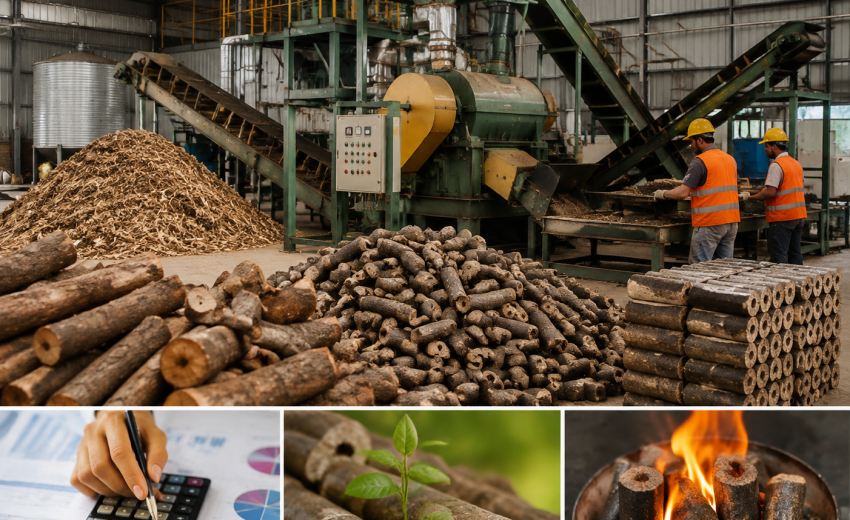
Starting a biomass briquetting plant means turning farm and industrial waste — like sugarcane bagasse, rice husk, sawdust, or cotton stalks — into compressed fuel briquettes that industries buy as a cheaper, cleaner alternative to coal. If you’re wondering how to start a biomass briquetting plant, the short answer is this: you need raw material access, a briquetting press machine, a small shed or factory space, working capital of roughly ₹15–40 lakh depending on scale, and the right state and pollution clearances. Done right, most plants recover their investment within 18 to 30 months.
This guide breaks down the full process — from planning to profit — in plain terms, so you know exactly what to expect before you invest.
What is a biomass briquetting plant, and why does it matter?
A biomass briquetting plant compresses loose agricultural or industrial waste into dense, uniform blocks called briquettes. These briquettes burn longer, produce more heat, and release far less ash and smoke than raw biomass or coal.
Industries like textile dyeing units, food processing plants, brick kilns, and boilers use briquettes because:
- They cost less than coal per unit of heat generated
- They’re a renewable, low-emission fuel source
- They help units meet pollution control board norms
- They reduce dependence on imported fuel
Because demand for cleaner industrial fuel keeps growing, cities with strong manufacturing bases — including Rajkot — have seen steady interest in briquette plants over the last few years. Rajkot’s cluster of ceramic units, textile dyeing houses, and engineering workshops creates a natural local market for biomass fuel, which is one reason entrepreneurs in Rajkot are exploring this business.
How to start a biomass briquetting plant: step-by-step
Here’s the practical sequence most successful plant owners follow.
1. Research your local raw material supply
Before anything else, map out what waste is available near you — groundnut shells, cotton stalks, wood waste, or agro residue are common in Gujarat, including around Rajkot. Consistent, low-cost raw material is the single biggest factor in profitability.
2. Draft your biomass briquetting plant business plan
A solid biomass briquetting plant business plan should cover:
- Raw material sourcing strategy and backup suppliers
- Machine capacity (tons per hour)
- Target buyers (boiler units, kilns, factories)
- Staffing needs
- Total project cost and funding source
- Break-even timeline
3. Choose the right machinery
Your briquetting press is the heart of the plant. Options range from manual hydraulic presses for small setups to fully automatic screw or piston presses for larger operations.
4. Register your business and get clearances
You’ll typically need:
- MSME/Udyam registration
- GST registration
- Factory license (as applicable)
- Pollution control board consent (since it’s a manufacturing unit)
- Fire safety NOC
5. Set up the plant and start production
Once machinery is installed and raw material supply is confirmed, most small-to-mid plants can begin trial production within 4–6 weeks.
What does a biomass briquetting plant cost?
The biomass briquetting plant cost depends heavily on capacity. Here’s a general breakdown for planning purposes (actual figures vary by machine brand, location, and automation level):
Plant Scale | Approx. Capacity | Estimated Investment | Suitable For |
Small | 300–500 kg/hr | ₹10–18 lakh | First-time entrepreneurs, local supply |
Medium | 1–1.5 tons/hr | ₹20–35 lakh | Regional supply to nearby industries |
Large | 2+ tons/hr | ₹40 lakh and above | Bulk contracts, export potential |
This biomass briquetting plant investment usually covers the press machine, dryer (if needed), shed construction, electrical setup, and initial working capital. Land cost is separate and depends heavily on whether you buy, lease, or use existing space.
If you’re asking how much it costs to start a biomass briquette plant on a shoestring budget, a small manual-press unit can technically start under ₹10 lakh — but automation pays for itself quickly through higher output and lower labor cost.
How profitable is a biomass briquetting plant?
Profitability comes down to three numbers: raw material cost, selling price per ton, and machine uptime.
A rough profit snapshot for a medium-scale plant:
- Raw material cost: ₹2,000–3,500 per ton
- Selling price of briquettes: ₹6,000–8,000 per ton
- Gross margin: ₹2,500–4,500 per ton (before overheads)
So, how profitable is a biomass briquetting plant in real terms? Most well-run plants with steady buyers report net margins of 20–30% once fixed costs are covered — but this depends entirely on consistent raw material sourcing and reliable customers.
How do you calculate biomass briquette plant ROI?
To calculate biomass briquette plant ROI, use this simple formula:
ROI = (Net Annual Profit ÷ Total Investment) × 100
For example, if you invest ₹25 lakh and generate a net annual profit of ₹8 lakh, your ROI works out to 32% per year — meaning you’d recover your investment in roughly 3 years.
Factors that speed up or slow down ROI
- Speeds it up: long-term supply contracts with local factories, running the plant close to full capacity, minimal machine downtime
- Slows it down: seasonal raw material shortages, high transport costs, low-capacity utilization in the first year
Biomass briquetting plant business plan: key components table
Component | What to Include |
Executive summary | Business goal, location, target capacity |
Market analysis | Local demand from Rajkot-area industries, competitor pricing |
Raw material plan | Suppliers, seasonal availability, storage |
Machinery plan | Press type, capacity, supplier |
Financial plan | Investment breakdown, ROI timeline, funding source |
Regulatory plan | Licenses, pollution clearances, land use approval |
Why location matters: setting up in Rajkot
Rajkot’s industrial base — spanning textiles, ceramics, castings, and engineering — creates steady local demand for briquette fuel, which lowers transport costs for new plant owners in the region. Setting up in or near Rajkot also gives easier access to agricultural residue from surrounding districts, which helps keep raw material costs predictable. For entrepreneurs evaluating where to base a new plant, Rajkot’s mix of industrial demand and raw material availability makes it a practical starting point.
If you’re setting up in Rajkot and need reliable equipment from the start, Ronakeng provides biomass briquetting machines built for Indian industrial conditions, with support for plant planning and after-sales service — a useful starting point if you’d rather not navigate machine selection alone.
Conclusion
Starting a biomass briquetting plant isn’t complicated, but it does reward careful planning. Get your raw material supply chain right, choose machinery that matches your realistic capacity needs, and line up buyers before you scale up production. Investment can range from ₹10 lakh for a small unit to ₹40 lakh-plus for a larger, automated setup, and most plants see a return within two to three years when raw material and demand stay steady. Whether you’re exploring this in Rajkot or elsewhere, the fundamentals stay the same: solid planning, dependable supply, and the right machinery from a trusted manufacturer like Ronakeng can make the difference between a plant that struggles and one that turns a steady profit.
Frequently asked questions
- How much land is needed for a biomass briquetting plant? A small plant typically needs 2,000–4,000 sq. ft., including space for raw material storage, the press unit, and finished goods stacking.
- Is a biomass briquetting plant profitable in the first year? Most plants break even on operating costs within the first year but take 2–3 years to fully recover the initial investment, depending on capacity utilization.
- What raw materials work best for briquetting? Groundnut shells, rice husk, sawdust, cotton stalks, and bagasse are among the most commonly used and cost-effective options, especially in agricultural regions like Rajkot.
- Do I need a pollution control license to start this business? Yes. Since it’s a manufacturing operation, you’ll need consent from your state pollution control board along with standard business registrations.
- How do I find buyers for briquettes near Rajkot? Local textile dyeing units, ceramic factories, and boiler-operated industries are common buyers. Direct outreach and sample testing with nearby factories is usually the fastest way to secure your first contracts.