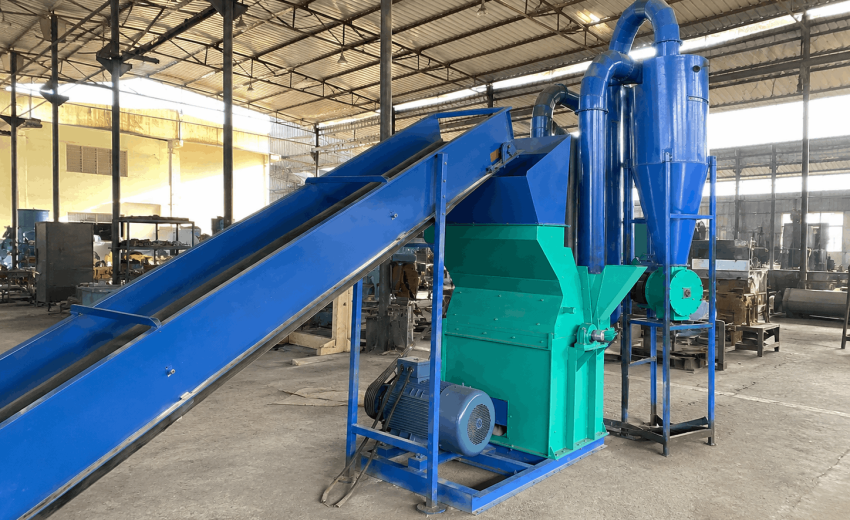
If you want to produce quality biomass briquettes, pellets, animal feed, or processed agricultural materials, understanding the Hammer Mill Working Principle is important. A hammer mill reduces the size of raw materials by using high-speed rotating hammers that repeatedly strike and break them into smaller particles.
In simple terms, raw material enters the machine through a feeding system, moves into the grinding chamber, gets crushed by rotating hammers, and is then separated and collected as fine material. This process makes hammer mills an essential machine in biomass processing, briquetting plants, pellet plants, feed mills, and many other industries.
What is a hammer mill?
A hammer mill is a size reduction machine used to crush, grind, and pulverize various materials into smaller particles.
It is commonly used for processing:
- Agricultural waste
- Wood chips
- Sawdust
- Groundnut shells
- Cotton stalks
- Bamboo waste
- Rice husk
- Animal feed ingredients
- Biomass materials
The machine helps create a uniform particle size, which is important for further processing such as briquetting, pelletizing, and fuel production.
What is the Hammer Mill Working Principle?
The Hammer Mill Working Principle is based on impact force.
Inside the grinding chamber, a rotor fitted with multiple hammers rotates at high speed. When raw material enters the chamber, the hammers strike it repeatedly. These impacts break the material into smaller pieces.
The crushed material continues moving inside the chamber until it becomes small enough to pass through a screen. Once it passes through the screen openings, it exits the grinding system as finished material.
The process can be summarized as follows:
- Raw material enters the machine.
- Rotating hammers strike the material.
- Material breaks into smaller particles.
- The screen controls particle size.
- Processed material is collected for further use.
This simple but effective mechanism is the reason why the Hammer Mill Working Principle is widely used across multiple industries.
How does a hammer mill system work?
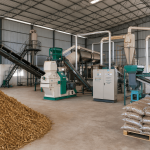
A modern hammer mill system consists of several connected components working together.
The complete process looks like this:
Step 1: Feeding the raw material
Raw material is loaded onto the feed conveyor.
The conveyor transports material to the feed hopper in a controlled manner. Consistent feeding helps improve machine performance and prevents overloading.
Step 2: Material enters the grinding chamber
From the feed hopper, material enters the hammer mill grinding chamber.
This is where the actual size reduction takes place.
Step 3: High-speed hammer impact
Inside the chamber, rotating hammers strike the material continuously.
The material breaks down into:
- Direct hammer impact
- Particle-to-particle collision
- Contact with the chamber walls
This is the core of the Hammer Mill Working Principle.
Step 4: Screening process
The material remains inside the grinding chamber until it reaches the required particle size.
A screen installed inside the machine controls the final output size.
- Smaller screen holes produce finer material.
- Larger screen holes produce coarser material.
Step 5: Material transportation
After grinding, the blower creates airflow that moves the processed material toward the cyclone separator.
Step 6: Material separation
The cyclone separator separates solid material from the air stream.
The processed material settles and moves toward the discharge section.
Step 7: Dust collection
The dust collection system captures fine airborne particles generated during grinding.
This helps maintain:
- Cleaner operations
- Better worker safety
- Reduced material loss
Step 8: Finished material discharge
The processed material is collected at the discharge point and becomes ready for:
- Briquette manufacturing
- Pellet production
- Fuel preparation
- Industrial processing
What does a hammer mill component diagram show?
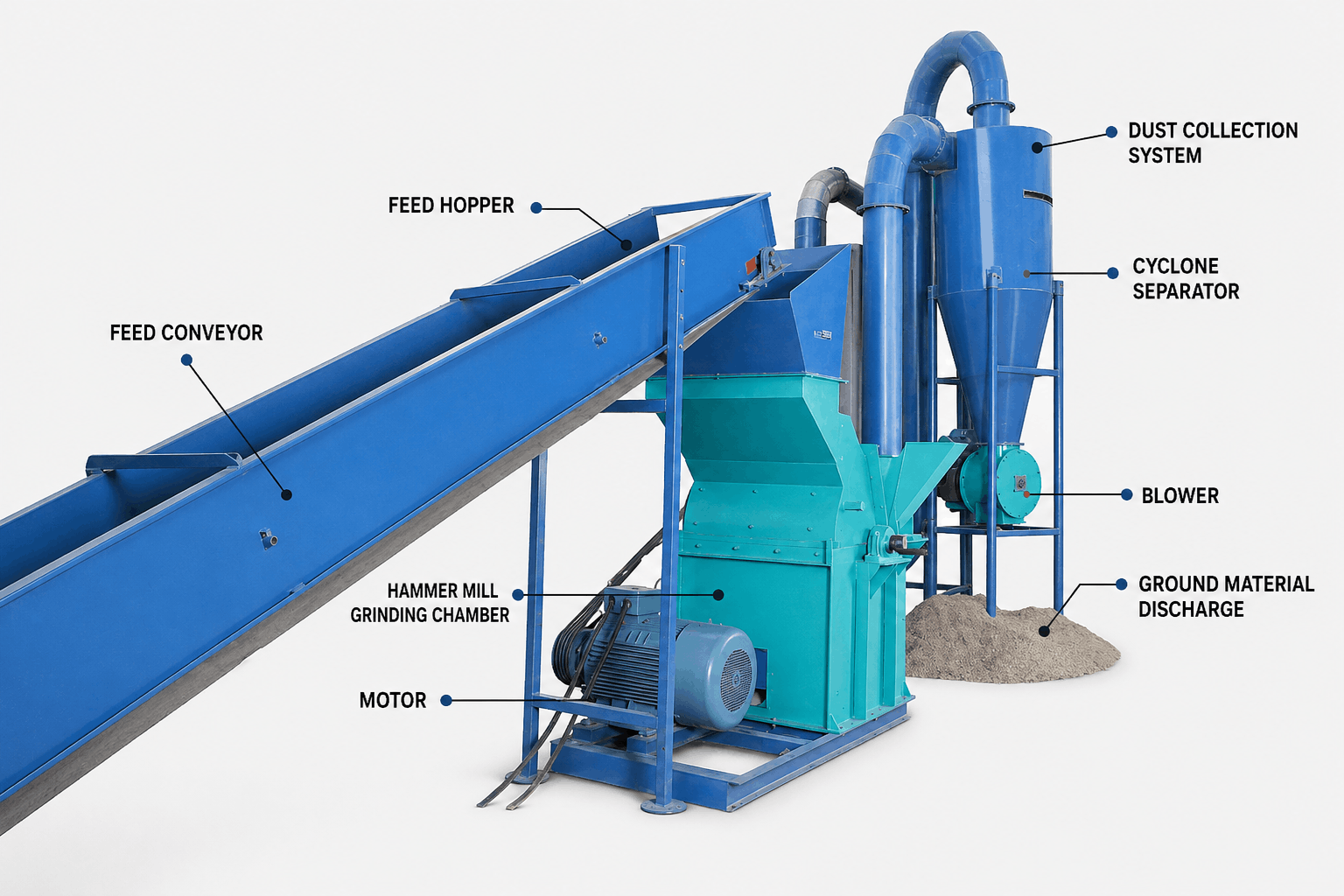
A hammer mill components diagram helps operators understand how different parts work together to perform grinding efficiently.
Instead of showing only internal parts, a complete hammer mill system diagram explains the entire material flow from feeding to final discharge.
Feed conveyor
The feed conveyor transports raw material into the system.
It ensures a continuous and controlled supply of material to the hammer mill.
Feed hopper
The feed hopper receives material from the conveyor and directs it into the grinding chamber.
Proper feeding helps maintain consistent machine performance.
Hammer mill grinding chamber
The grinding chamber is the main working section of the machine.
Inside this chamber are the rotor shaft and hammers that perform the grinding operation.
Rotor shaft and hammers
The rotor shaft rotates at high speed and drives the hammers.
These hammers repeatedly strike the material and reduce its size.
Although these parts are located inside the grinding chamber and may not be visible externally, they are the most important components responsible for the Hammer Mill Working Principle.
Motor
The motor supplies power to the entire grinding system.
Motor capacity directly affects production performance and machine output.
Blower
The blower generates airflow that moves processed material from the grinding chamber to the cyclone separator.
Cyclone separator
The cyclone separator separates material from the airflow.
This improves collection efficiency and reduces product loss.
Dust collection system
The dust collection system captures fine dust particles generated during grinding.
This helps create a cleaner working environment.
Ground material discharge
This is the final collection point where processed material exits the system.
The material can then be used for further production processes.
Why is particle size important in biomass processing?
Particle size has a direct impact on production quality.
When materials are ground properly:
- Briquettes become denser
- Pellets become stronger
- Fuel burns more efficiently
- Production becomes more consistent
- Equipment performance improves
Poor grinding often leads to low-quality finished products and higher operational costs.
Which industries use hammer mills?
Because the Hammer Mill Working Principle is simple and highly effective, these machines are used in many industries.
Biomass briquetting plants
Hammer mills process agricultural waste before briquette production.
Biomass pellet plants
They prepare raw material for pellet manufacturing.
Animal feed industries
Feed ingredients are ground into uniform particles.
Wood processing industries
Wood waste and wood chips are converted into smaller sizes.
Paper and pulp industries
Various raw materials are processed before manufacturing.
Recycling facilities
Different recyclable materials are reduced in size for further processing.
What are the benefits of using a hammer mill?
A hammer mill offers several advantages:
- Fast material processing
- Uniform particle size
- High production capacity
- Easy operation
- Low maintenance requirements
- Suitable for multiple materials
- Reliable performance
These benefits make hammer mills one of the most commonly used grinding machines in industrial processing.
Also read: How to Improve the Efficiency of A Hammer Mill?
Frequently Asked Questions About Hammer Mills
What is the Hammer Mill Working Principle?
The Hammer Mill Working Principle uses high-speed rotating hammers to strike and break materials into smaller particles until they pass through a screen.
What materials can be processed in a hammer mill?
Hammer mills can process wood chips, sawdust, crop residues, bamboo waste, rice husk, groundnut shells, cotton stalks, animal feed materials, and many other biomass products.
How is particle size controlled in a hammer mill?
Particle size is controlled by the screen installed inside the grinding chamber. Smaller screen holes produce finer material.
Why is a blower used in a hammer mill system?
The blower helps transport processed material from the grinding chamber to the cyclone separator through airflow.
Why is a hammer mill important for briquetting plants?
A hammer mill creates a uniform particle size, which is essential for producing high-quality briquettes with better density and combustion performance.
Final Thoughts
Choosing the right processing equipment is critical if you want to optimize your production line, save on energy costs, and minimize downtime. If you are looking to invest in a durable and high-performing setup for your factory, it helps to source from proven global experts. Ronak Engineering is a leading Hammer Mill Machine Manufacturer & Exporter in India, providing heavily tested, industrial-grade crushing systems tailored to handle tough biomass waste, agricultural residues, and industrial materials with maximum energy efficiency.